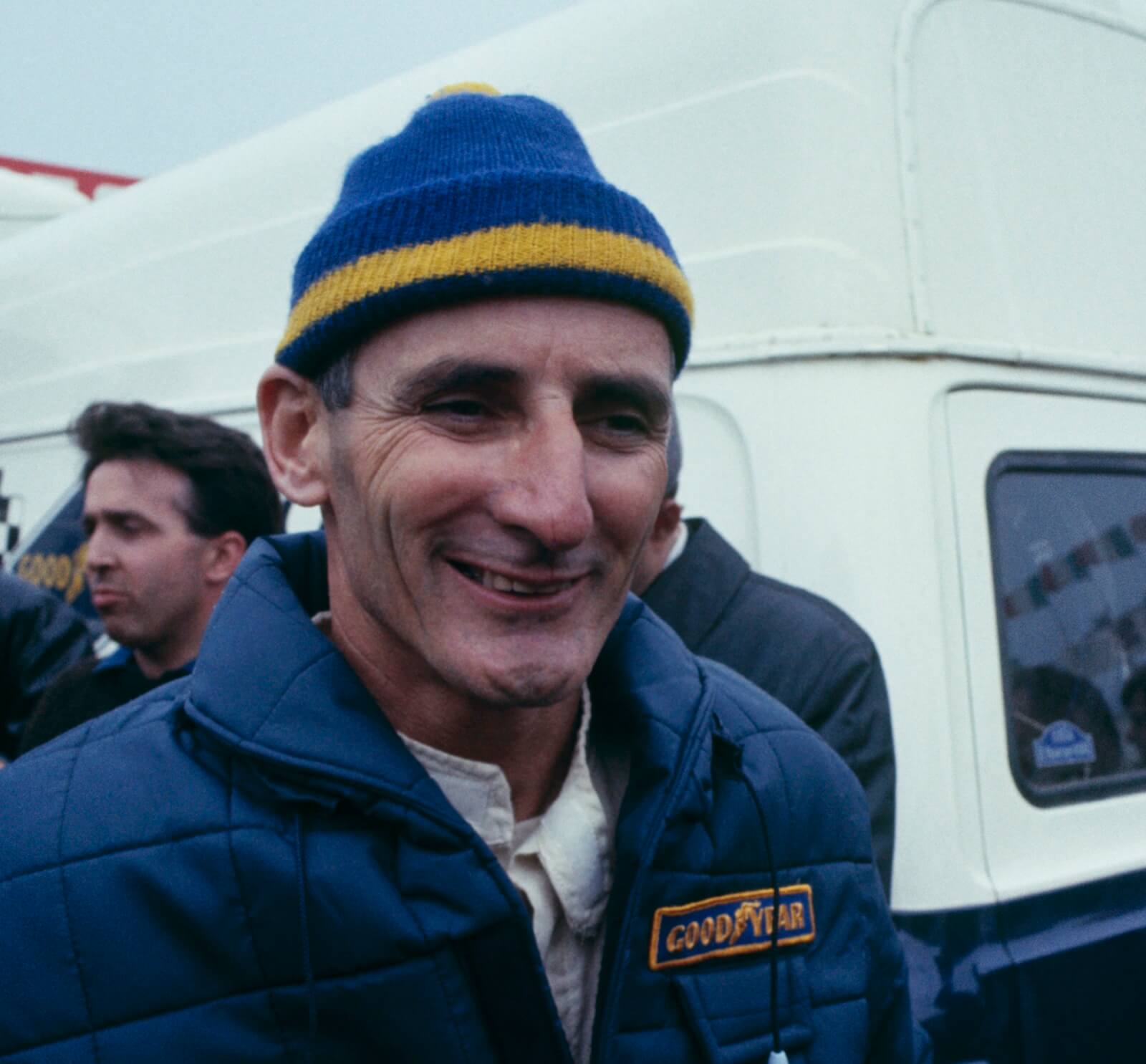
Ken Miles had moved from England to California in 1952 and began racing MG TDs for his employer Gough Industries which led to his first MG-based special, the R1 (https://dmtrg.com/ken-miles-mg-special-r1/). Miles was a brilliant race engineer, from car design and construction to race prep and suspension set-up, and also a ferociously quick race driver, culminating in exploits at Sebring and Le Mans with the Ford GT40
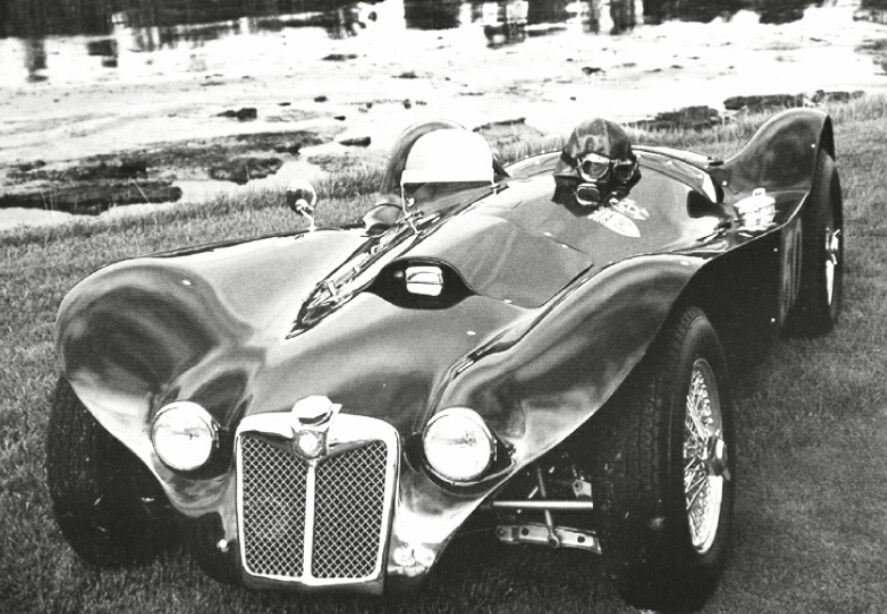
A next step in Ken Miles race engineering life… The MG Special R2 was an MG-based racing car built by Ken Miles in California during the winter of 1954-55. It was designed to be lower, smaller, and faster than its predecessor, his more conventional MG Special R1 of 1953. The car was immediately identifiable by its very low seating position, its low center of gravity and the flat visual-aspect streamlined bodywork designed by Robert Cumberford1 who had also designed the Parkinson Jaguar (https://dmtrg.com/terry-buffum-1949-parkinson-jaguar-special/). R2 was quickly named by press writers and fans The Flying Shingle (a shingle is a thin wood or slate used to cover roofs or walls, in the UK a slate or a tile). To this day it is one of the most iconic early California road-racing specials.
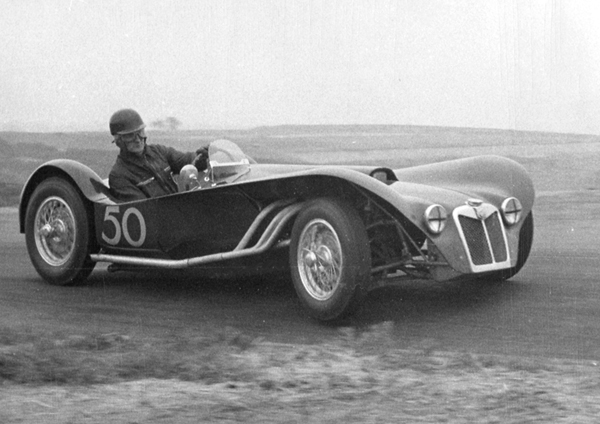
Technical specs… The MG Special R2 racer was conceived by Miles and constructed in a similar fashion to the first – a tubular frame with modified MG Y suspension – but incorporated many key mechanical and design changes. Many MG components were still utilized, such as the standard MG TC gearbox and a 1496cc MG XPEG engine – although highly-modified. This unique engine and the MG TC gearbox came out of Ken Miles’s MG R1 Special when he sold it. The space frame chassis was constructed from one-inch steel tubing which was lighter than its R1 predecessor but still retained the structural rigidity. To reduce the frontal area, the driving position was lowered by nearly four inches. Other techniques were used to reduce the frontal area; the engine was tilted down in the front which did much to achieve this goal. The car was narrow and low, which meant changes were needed to fit all the engine components in the engine bay. The MG intake manifolds were installed upside down which allowed the carburetors to be angled and fit under the hood. Some sources say it took 4500 man-hours to complete the car. The differences from R1 were striking; the wedge-like rake was one thing, the fully-enveloped body with fenders that flared up and over the front and rear wheels was another.
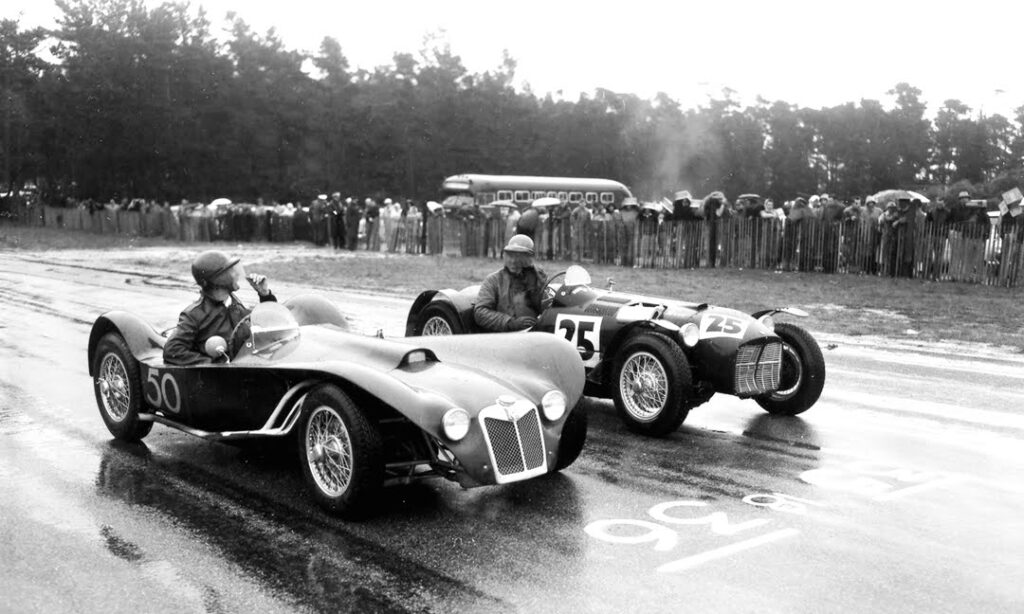
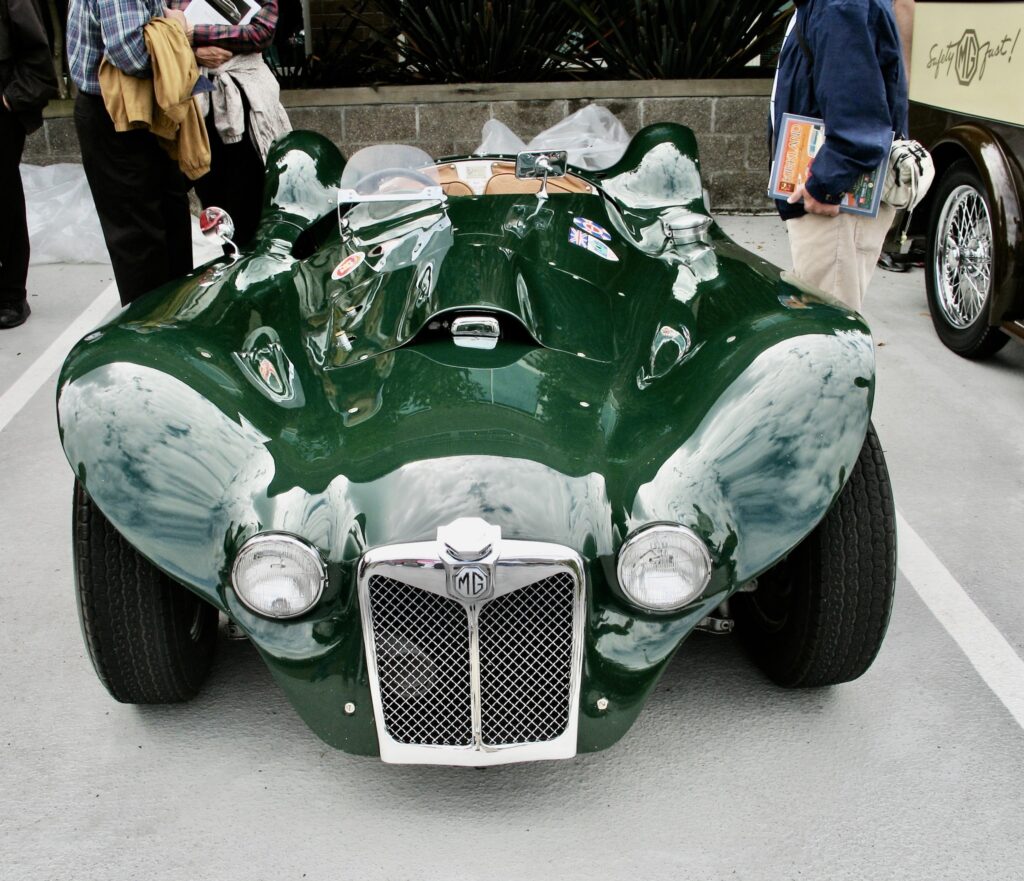
MG parentage… The design of the radiator grille was similar to the MG TF to help brand recognition and sales of the MG line of vehicles. In the front was an MG-style grille with headlights on either side and the MG badge, and the car finished in British Racing Green. Why promote MG street cars? Like the R1, Ken Miles, Lorentz Melvold and Arne Bjorkli were paid to build the car by Gough Industries2, the MG importer for California.
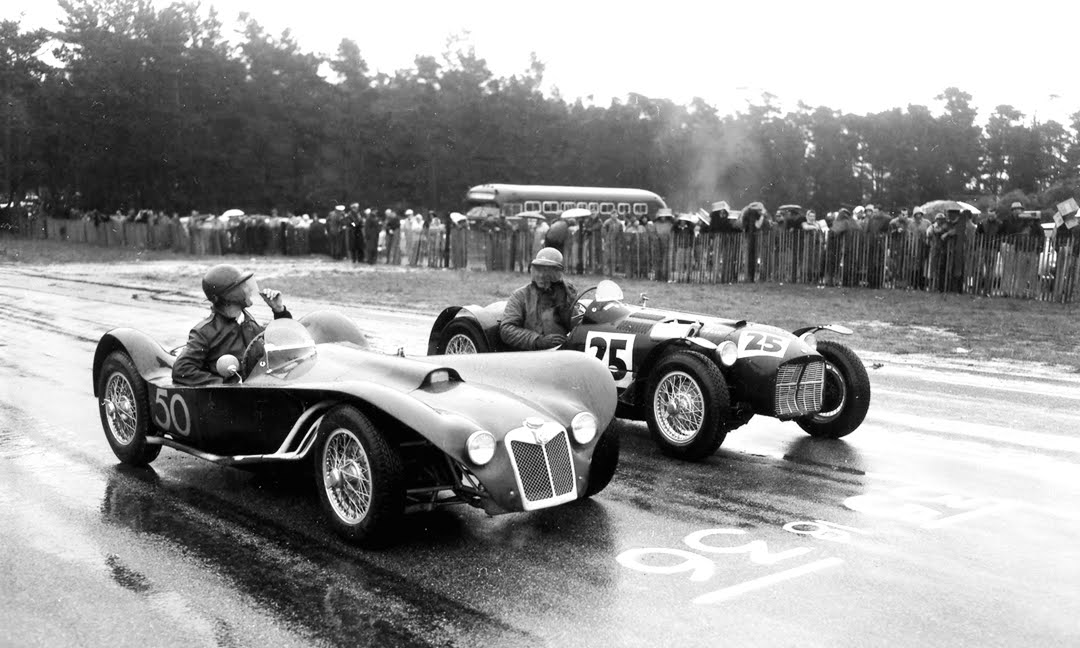
Racing successes… Ken Miles drove the R2 in the SCCA’s F Modified class and was very successful. R2’s inaugural race was in 1955 at Willow Springs but Ken failed to finish. He was victorious In the 1500cc-and-under Modified class and even in several Over-1500cc main events in many of the races he entered. Among its accomplishments were a 1st place finish in the Pebble Beach Cup and 3rd in the Del Monte Trophy Races at the Pebble Beach Road Races in 1955, and a win at Torrey Pines. Those results in such high profile venues cemented his reputation as a top driver. Miles remembered where he had come from and carried the decal from his membership in the British Racing Drivers Club on his car. Here it is, getting the once over from an admirer, in the paddock at its first race, held at Willow Springs in February 1955.
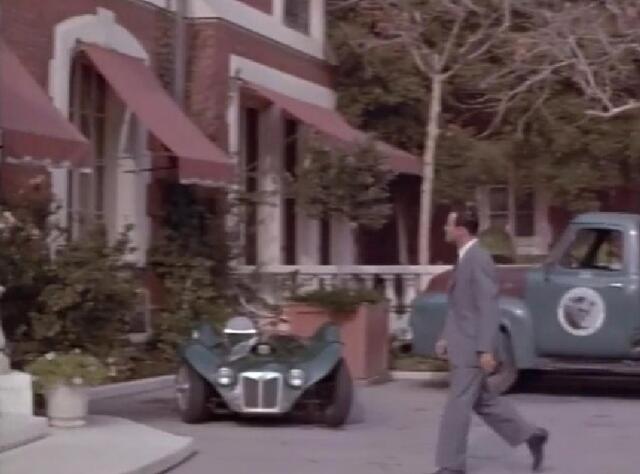
The Flying Shingle appeared the 1956 movie “You Can’t Run Away From It” (a poor remake of Capra’s classic “It Happened One Night”). The image (right) is a still from the movie; appearing with the car is Jack Lemmon.
Ken Miles after R2…The arrival of the first Porsche 550 Spyders would eventually make an MG Special R2 an also-ran in the F-Modified Class, so Miles switched to a Porsche owned by Johnny von Neumann and continued to win the class. Ken Miles’s next project, R3, was the Porsche and Cooper hybrid, the Cooper Porsche Special (oft referred to as the Pooper). Miles sold the MG R2 “Flying Shingle” to Otto Zipper. Zipper, a well-known Los Angeles-based European car dealer, who campaigned the car. R2 continued to compete in racing events after Miles moved on to driving for John von Neumann. In the 1960s Miles worked with Carroll Shelby driving Cobras with great success. He was tragically killed in a testing accident with the Ford J-car, the forerunner of the Ford GT40 Mk. IV, at Riverside Raceway in August 1966. Read more about Ken Miles here on this web site at https://dmtrg.com/ken-miles/.
Owners of the Ken Miles MG Special R2 …
Gough Industries 1954-1955
Ken Miles 1955-1957
Otto Zipper 1957-?
Pat Hart 198?- 2001
Charles (Chuck) Hart 2001-2023
Bill Hart 2023-present
Today The Flying Shingle, fully restored, still competes in historic racing.
With thank to Daniel Vaughan’s article of April 2007, the Klemantaski Collection (including Peter Coltrin, https://klemcoll.wordpress.com/2016/01/02/the-flying-shingle/) and the Pebble Beach Concours whose data all informed this article.
Read about Ken Miles’s previous creation, the MG Special R1, at https://dmtrg.com/ken-miles-mg-special-r1/
Read about Ken Miles’s life on this web site at https://dmtrg.com/ken-miles/
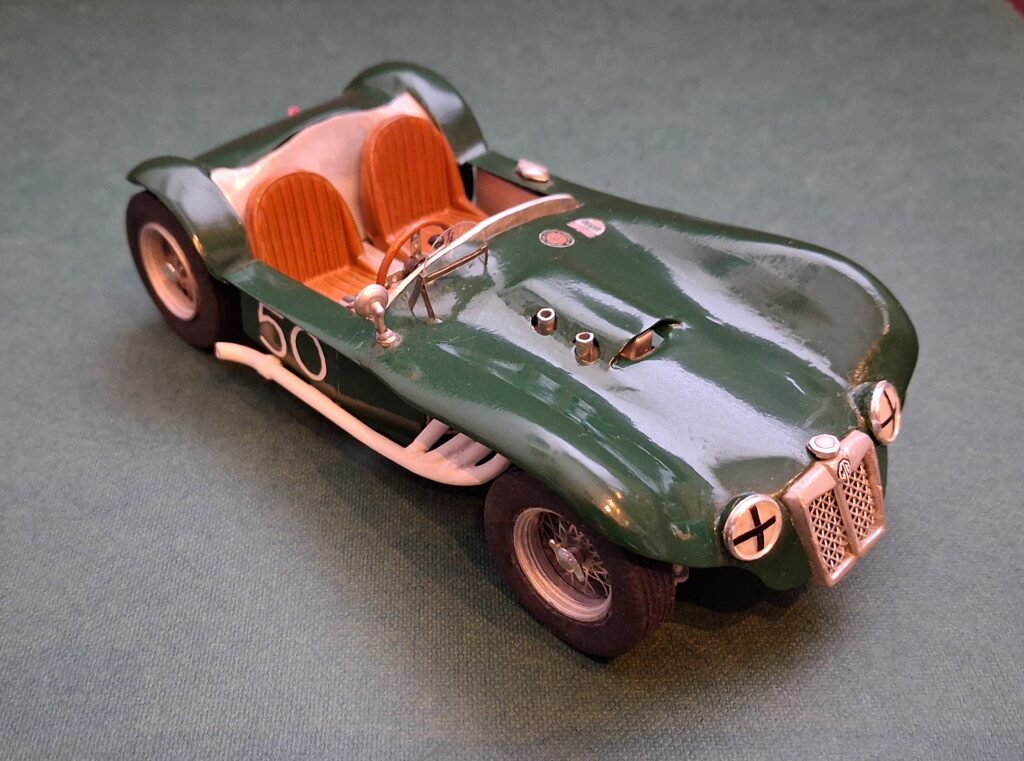
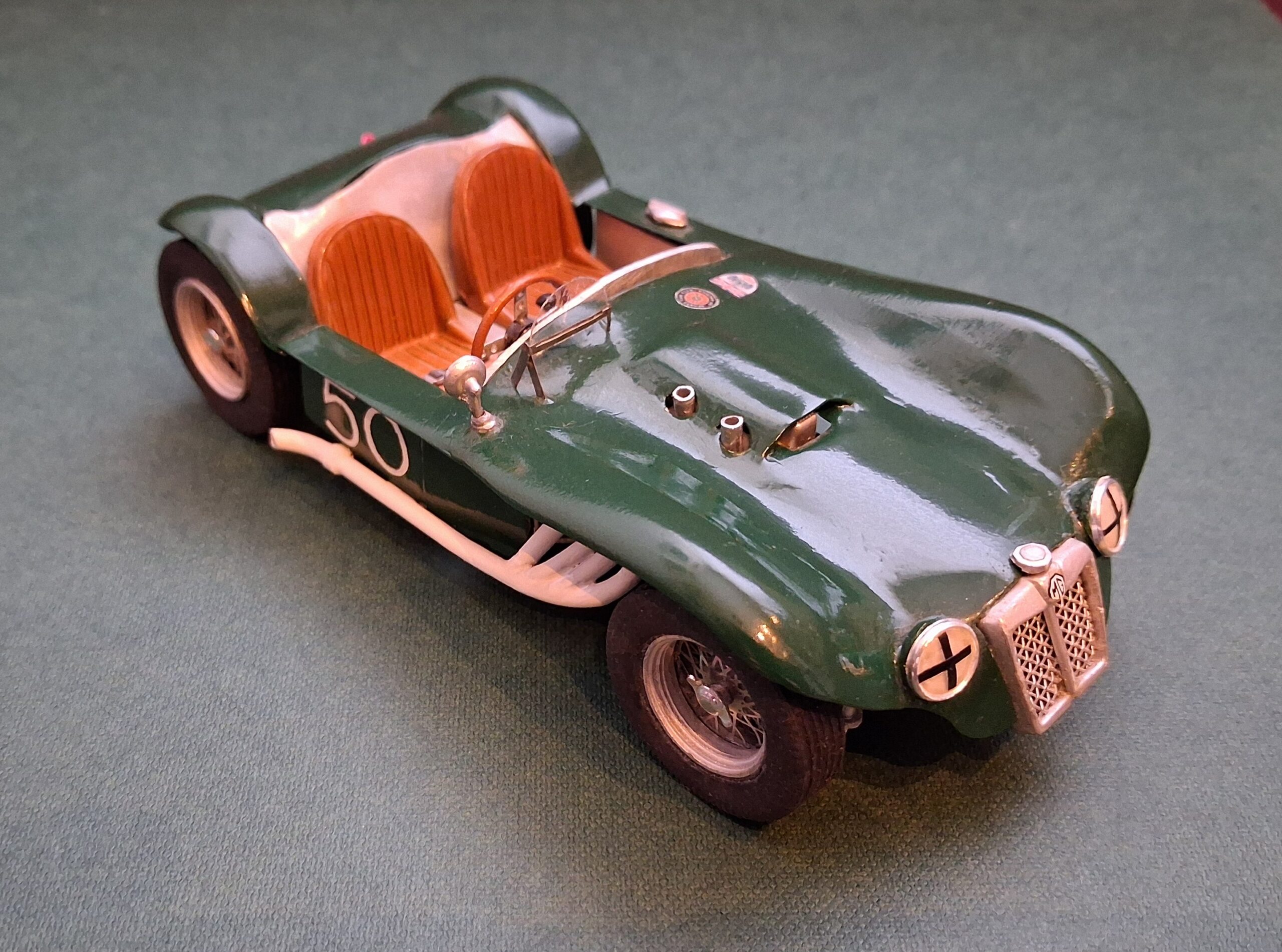
Read about Paul House’s collection of models of all the cars driven by Ken Miles at https://dmtrg.com/ken-miles-in-miniature/ (photo, right)
This article was compiled and written by Marcus Bicknell
in April 2026 with well-informed factual editing from Rob Manson.
You can browse the gallery below by clicking on an image and scrolling left or right. The filename at the bottom of the image gives details of the image
- Robert Cumberford (born 1935), former automotive designer for General Motors, author and design critic – widely known as Automotive Design Editor and outspoken columnist for Automobile magazine. In his early career he designed two automobiles, the Parkinson Jaguar Special and the Ken Miles Flying Shingle.
https://en.wikipedia.org/wiki/Robert_Cumberford ↩︎ - In the 1950s, Gough Industries Inc. operated as a major distributor and dealership for British Motor Corporation (BMC) vehicles in Southern California. Based in the Los Angeles area, they played a significant role in importing and distributing marques like MG and Austin-Healey during the British car boom in the United States. ↩︎