


Chris MacAllister will race his 1955 Jaguar D Type with us again at the Rolex Monterey Historic Reunion Aug 14-17 2024 at Laguna Seca,
California. The Briggs Cunningham Trophy race group in which we (the Del Monte Trophy race group for which this Facebook page and www.dmtrg.com are kept up to date) combines the DMTRG 1947-1955 cars with the later 1955-1960 cars. Only front engine cars from the later group are included.
Jaguar D-Type XKD 502 is #44 in the register of the Del Monte Trophy race group.
Chris MacAllister’s Jaguar D-Type XKD 502 was supplied brand new to Ecurie Ecosse May 1955 and proceeded to a stellar race calendar;
…1955 Daily Express Silverstone, Titterington, 6th;
Ulster Trophy, Titterington, 1st;
Dundrod, Titterington, 2nd on handicap;
Nürburgring, Titterington crashed; rebuilt by works;
Charterhall, Sanderson, 5th & 4th;
Snetterton, Sanderson, 2nd; Crimond, Smith, 3rd x 2;
September, Aintree, Sanderson,1st;
…1956, Snetterton, Brown, 3rd, Sanderson 4th;
Goodwood, Brown, 2nd;
Oulton Park. Sanderson, 4th;
Aintree, Flockhart, 3rd;
Charterhall, Sanderson, 1st, Flockhart, 1st;
Silverstone, Brown, 2nd in class;
Spa, Sanderson,1st;
Goodwood, Titterington, 1st & 3rd;
Aintree, Titterington, 2nd;
Reims, Flockhart/Sanderson, 4th;
Silverstone, Titterington, 1st in class;
Kristianstad, Titterington/Flockhart, ret’d;
Goodwood, Sanderson, 5th;
(https://www.racingsportscars.com/chassis/results/XKD%20502.html)
... late 1956 sold to Maurice Charles (Cardiff, UK);
…1958 crashed and rebuilt, possibly using body from XKD 508;
XKD 502 competed twice at Le Mans with maurice Charles driving, but unsuccessfully.
22.6.1958 24h Le Mans – Charles / Young DNF
21.6.1959 24h Le Mans – Maurice Charles DNA
early 1960s fitted with IRS, but later removed; later owners included Jack Alderslade, Michael McGrath, Hexagon of Highgate, David Clifford, Robert Cooper, Vic Norman (who had car rebuilt at Lynx mid-1980s), Hon Patrick Lindsay & Albert Obrist; sold to Yoshijuki Hayashi (Japan); 1995 sold to Peter Rae (UK) and then to Chris MacAllister, the owner in 2024 when this was written. UK Road Registration was MWS 302.
Jaguar D-type #XKD 502
Front-engined: Jaguar XK L6 2v DOHC 3442 cc
Ecurie Ecosse (GB) Open bodywork
1st appearance: 7 May 1955 at Silverstone driven by Desmond Titterington (GB). Result: 6th. Sponsors: unknown
Registration: MWS 302
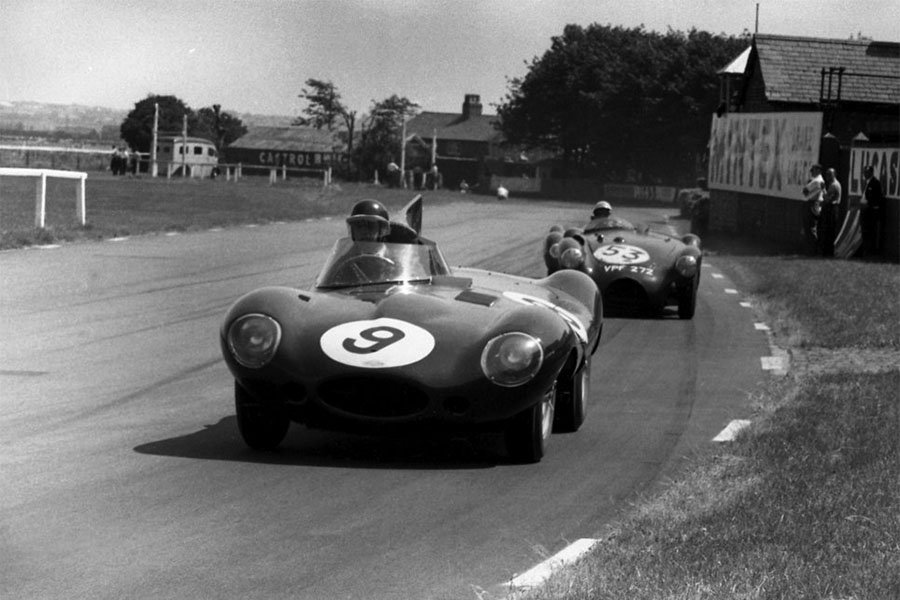
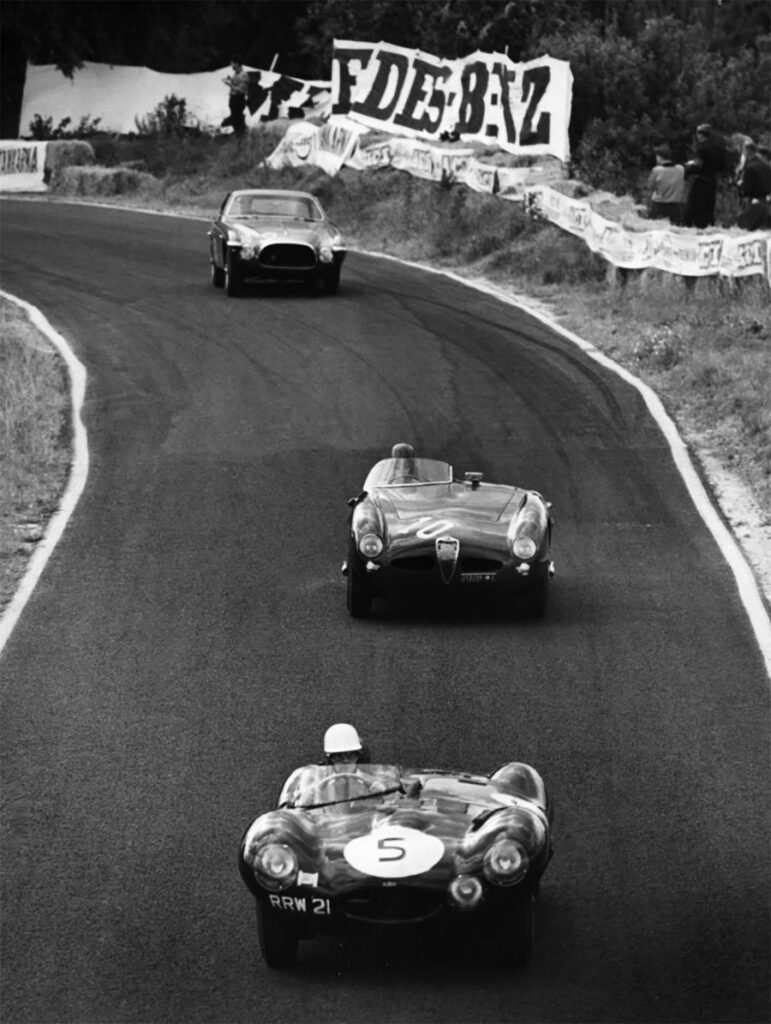
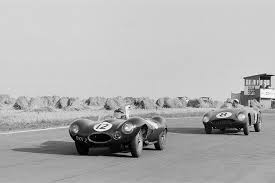
The Jaguar D-Type is a sports racing car that was produced by Jaguar Cars Ltd. between 1954 and 1957. Designed specifically to win the Le Mans 24-hour race, it shared the straight-6 XK engine and many mechanical components with its C-Type predecessor. Its structure, however, was radically different, with innovative monocoque construction and slippery aerodynamics that integrated aviation technology, including in some examples a distinctive vertical stabilizer. Engine displacement began at 3.4 litres, was enlarged to 3.8 L in 1957, and reduced to 3.0 L in 1958 when Le Mans rules limited engines for sports racing cars to that maximum. D-Types won Le Mans in 1955, 1956 and 1957. After Jaguar temporarily retired from racing as a factory team, the company offered the remaining unfinished D-Types as street-legal XKSS versions, whose perfunctory road-going equipment made them eligible for production sports car races in America. In 1957 25 of these cars were in various stages of completion when a factory fire destroyed nine of them. Total production is thought by some to have totaled 71 D-Types, including 18 for factory teams and 53 for privateers (plus an additional 16 D-Types were converted into road-legal XKSS versions).
The design applied aeronautical technology, revolutionary at the time. The “tub”, or cockpit section, was of monocoque construction, mostly comprising sheets of aluminium alloy. Its elliptical shape and comparatively small cross-section provided torsional rigidity and reduced drag. To the front bulkhead was attached an aluminium tubing subframe for the engine, steering assembly, and front suspension. Rear suspension and final drive were mounted to the rear bulkhead. Fuel was carried in the tail and the designers followed aviation practice by specifying a deformable Marston Aviation Division bag in place of a conventional tank. The aerodynamic influence was partly the work of Malcolm Sayer, who had joined Jaguar following a stint with the Bristol Aeroplane Company during the Second World War and later worked on the C-Type. The D-Type required a minimal frontal area. To reduce the XK engine’s height dry sump lubrication was developed, and it has been said that the car’s frontal area was also a consideration in canting the engine at 8½° from the vertical (which necessitated the offset bonnet bulge). Philip Porter, in his book Jaguar Sports Racing Cars, says that “[a] more likely reason was to provide extra space for the ram pipes feeding the three twin-choke Weber carburettors.” Reducing underbody drag contributed to the car’s high top speed; for the long Mulsanne Straight at Le Mans, a fin was mounted behind the driver for aerodynamic stability. For the 1955 season, factory cars were fitted with a longer nose, which lengthened the car by 7½ inches and further increased maximum speed; and the headrest fairing and aerodynamic fin were combined as a single unit that smoothed the aerodynamics and saved weight.
Mechanically, many features were shared with the outgoing C-Type. Its front and rear suspension and innovative all-round disc brakes were retained, as was the XK engine. Apart from the new lubrication system, the engine was further revised as development progressed during the D-Type’s competition life. Notably in 1955, larger valves were introduced, together with asymmetrical cylinder heads to accommodate them. Elements of the body shape and many construction details were used in the Jaguar E-Type from 1961 to 1969. [Wikipedia]
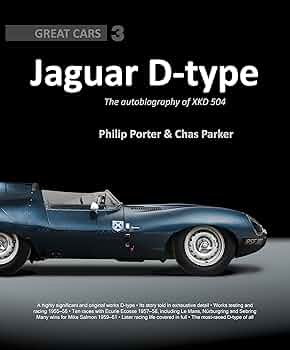
We thank Philip Porter for some this more-detailed info, the author of numerous books on the Jaguar marque. In additional to writing books and magazine articles and managing several businesses, he runs the XK Club and E-Type club from Worcestershire, England. His latest books include the Jaguar Scrapbook and the Stirling Moss 1929 – 1954 Scrapbook. Not all the images in our photo gallery, below, are of XKD 502.
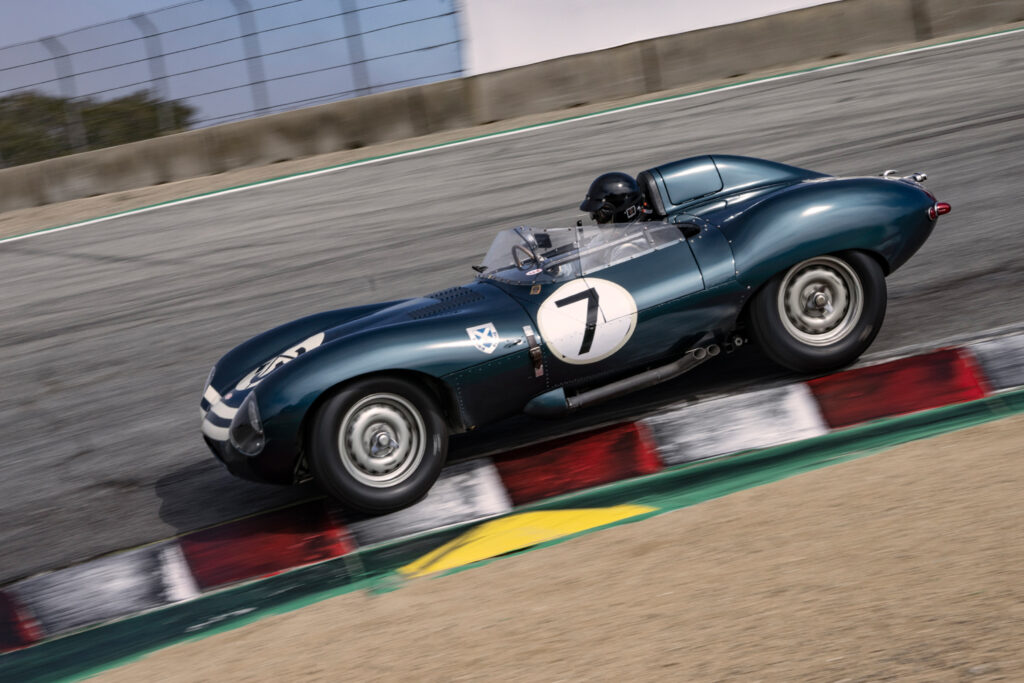


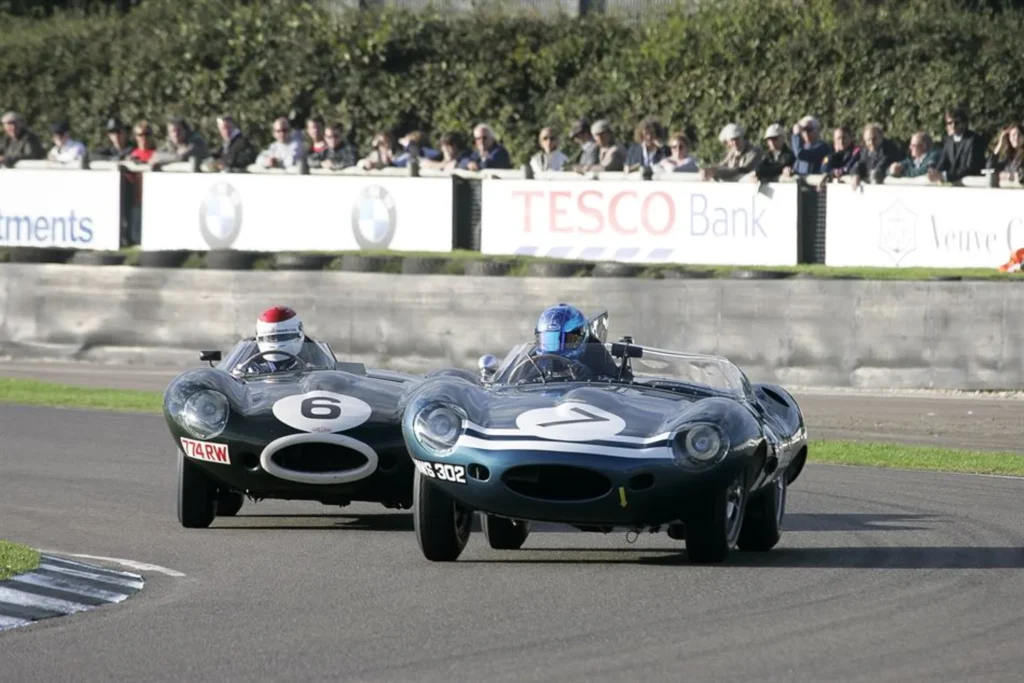

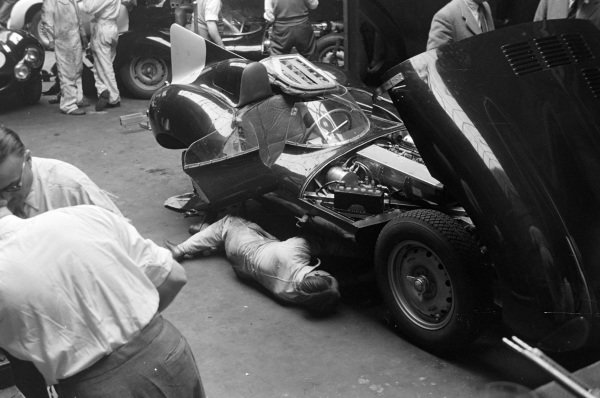
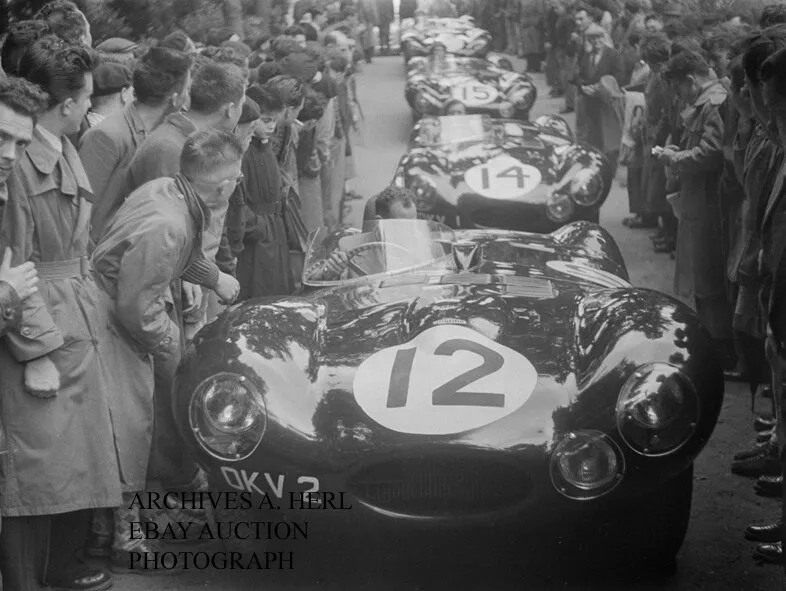
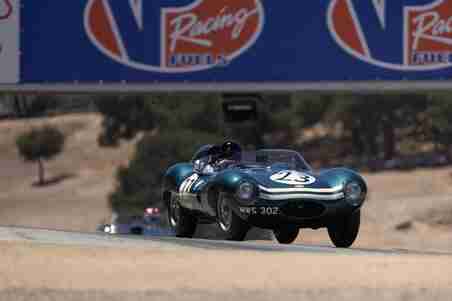
Thank you also to Tam McPartland for his photo shown here and in the MacAllister profile at https://dmtrg.com/chris-macallister/. See more of Tam’s work at http://tamsoldracecarsite.net/. Who can I credit for the Velocity Invitational 2023 snap?
Read more about Chris MacAllister of Indianapolis IN on our web site at https://dmtrg.com/chris-macallister/
http://www.coventryracers.com/cars/detail/?car=XKD502
https://www.historicgrandprix.com/Drivers/Chris%20MacAllister.htm