

… on the Californian Road Race Specials.
These race cars hold a unique place in the world history of motor racing. They may not be as familiar to motor fans as Jim Clark’s Lotus or the Can-Am monsters, but when in the 1950s the Ferraris, Maseratis, Porsches, Jaguars, Triumphs and Austin-Healeys arrived on the West Coast of the USA to race, several now notorious Californians just built their own… and went on to beat them on many occasions.
There were plenty of junkyards with suspension components from Model-T Fords and powerful flathead V8 engines; weld up a chassis, dream up a bodyshape, put it all together and go racing. Enzo Ferrari called Colin Chapman and John Cooper “”garagistes”, i.e. amateurs. What lofty term would he have used about Baldwin, Hagemann, Kurtis, Manning, Parkinson, Sorrell, Tatum and von Neumann who created the cars we love so much. Unique. I discussed this with David Steele, director of the American Hot Rod Foundation https://ahrf.com in the paddock at the August 2024 Rolex Monterey Motorsport Reunion at Laguna Seca. He’s respect for the owners of these cars driving them at full tilt in race conditions is more one of amazement. Read on…
Marcus >>> So, David, what’s your reaction to the Del Monte Road Racers, the cars that raced at Pebble Beach in the 50s? A couple of days with us here at Laguna Seca, David?
David Steele >>> Wow. Wow is the first thing that comes to mind. It is really mind-blowing. I mean, you guys are just such good people. It’s just so damn fun. You have just the right attitude about all of this, which is a great pairing with this group of cars, because these cars are about fun. The races that they originally were in were very competitive, but a lot of those guys were really just having fun. It was a social gathering initially. And then the races came from it.
Marcus >>> Take us back to the origins in the 1950s, which you know so well, at Pebble Beach when these cars arrived.
David Steele >>> Well, I mean, it’s the kind of thing that’s hard to believe. Pebble Beach is some of the most prized real estate in the world. And yet in 1950, the Del Monte Property Company was developing and building houses on the site; they were having trouble giving those lots away. And they weren’t sure how to promote that development. And they thought, why not have a sports car race on our twisty, windy roads through this beautiful forest. And so they did with the help of Sterling Edwards and Kjell Qvale (pronounced Shell Cavalli – ed.). And it’s an interesting thing that happened very quickly, because as you know, the letter was written in February of 1950, and the races happened in November. That’s a pretty quick, that’s a small window.
Marcus >>> And so here are these cool guys with Ferraris and Jaguars ready to compete here…
David Steele >>> They sure were. And you know, they had many things going for them. I mean, there was an MG importer and distributor, who was willing to kind of hit up his clientele, who were ready to go. They wanted to race those cars. It was one of the reasons they purchased them. So having that weekend sporty car character come into contact,
sometimes literally, with people like Richie Ginther and Phil Hill.
And guys who were white knuckle, no bullshit, racers.
Marcus >>> But then David Steele, you’re the director of the American Hot Rod Foundation. So you know about big American muscle, the V8 cars. And so the Ferraris, Jaguars and MGs, did not have it all their own way.
David Steele >>> They sure didn’t, no. And I think it was quite surprising to these guys who were aficionados, who bought, purchased these cars as quote-un-quote, race ready. And you know, with the understanding that they have the cutting edge technology of the day. And who’s going to approach me and my Ferrari? Well, little did they know that Manning and Baldwin were to stick their hands up and say, I found some stuff down in the junkyard. I’m going to beat your ass. Yeah, and they did, and if they didn’t, they certainly put the heat on them.
Marcus >>> But that was second or third year of Pebble Beach, I presume that the American stars are getting on the pace.
David Steele >>> Yeah, I mean, they, I think they saw, well, for one thing, you had a lot of guys who observed the races became very energized by it, but they couldn’t afford a Ferrari, but they wanted to be competitive. And there was the problem. They just decided, well, I’m going to make my own car. And they saw these guys on the dry lakes, they’re going 140 miles an hour with these flathead V8 Fords. If I set that down into a chassis that’s purpose made, and I balance it and get the things sorted, I’m making more horsepower than a Ferrari. I’m lighter than a Ferrari. Maybe I have a chance. And so they did.
Marcus >>> Yeah. But then if you look at the downside of this amazing phenomenon of the hot rod road races, the Californian Road Races, now it’s a little bit of a backwater. Outside of this little West Coast environment, even on the East Coast, they are lesser known.
David Steele >>> It’s true. And it’s a great shame. Thanks to you, I was in the live stream announcer’s booth this morning talking about this very thing. Maybe this will be somewhat corrected next year when it’s the 75th and some attention will be given to these cars because what these cars were involved with starting all of this. All of this is here because these cars came together and raced. It was a social gathering as much as it was a competitive event, and kind of fancy folks showed up. You know, it came down from the Bay Area or wherever they were from or locals in their fancy cars and parked them together on a lawn, and someone decided, well, these are some very elegant cars. Why don’t we give someone a trophy? Well, that’s now the Pebble Beach Councours d’Elegance, I mean, the most respected concours on the planet. But the 1950s race cars are not there very often.
Marcus >>> It’s funny because the punters nowadays come into a race meeting, hoping for a big fire-eating Ford Mustang, a mega IMSA car or a Formula One car. And I get people coming up to the 1952 Streets Manning V8 Special saying, “My God, that’s a big Lotus 7. What is that?” So, you know, the awareness of these cars is negligible. I guess that’s a shame.
David Steele >>> It is a shame.
Marcus >>> You say that for the 75th Anniversary of the Pebble Beach races they’ll be brought back into stage. I’m not sure that’s the case. Even at the Rolex Monterey Motorsport Reunion, the 1950s road race cars are always down the bottom of the pecking order. And last year, for example, the streaming coverage when broadcast on television in the UK did not feature the 1950s race at all. Just omitted. It’s really a shame because these are the beginnings of it all.
David Steele >>> There’s an East Coast equivalent to this movement that happened with Cameron R. Argetsinger, Briggs Cunningham and William Milliken at Watkins Glen. But it’s the exact same thing, and that’s where the SCCA – the Sports Car Club of America – came from. And that is why that is so important. Kind of as a replacement to the pre-war organization ARCA, which the Collier brothers had it up. But these Del Monte Trophy cars are the west coast equivalent of that. And because of the climate, there are many more races out here. These cars, which can be used as road cars, can be used year round. So, they’re incredibly important cars. And they’re alive and well. Yeah, and they’re not rusting up. And again, I keep reiterating here, but these cars started all of this. And the fact that more people aren’t recognizing that is mind-boggling to me. So, whatever we can do. So, the cars don’t rust up in California. Rob Manson is essential to all this, because without him and the six cars he owns, we’d be poorer. Well, if we didn’t have a little patina on our edges, then people wouldn’t think we’re authentic.
Footnotes
Cameron Argetsinger was a visionary who, in 1948, conceived, organized, and drove in the first post-war road race in America through the roads of Watkins Glen. He brought Formula One to Watkins Glen International in 1961 and the circuit hosted the United States Grand Prix for 20 years. He was president of the IMRRC for five years, until his death in 2008. https://www.racingarchives.org/support-the-imrrc/cameron-r-argetsinger-award/
Briggs Swift Cunningham II (January 19, 1907 – July 2, 2003) was an American entrepreneur and sportsman. He is best known for skippering the yacht Columbia to victory in the 1958 America’s Cup race, and for his efforts as a driver, team owner, and constructor in sports car racing, including the 24 Hours of Le Mans. https://en.wikipedia.org/wiki/Briggs_Cunningham.
William F. Milliken, Jr. (April 18, 1911 – July 28, 2012) was an aerospace engineer, automotive engineer and racecar driver. Milliken competed in over 100 post-war road races. He was a founding member of the Watkins Glen Road Races, serving as head of the Rules Committee. He competed in the very first Watkins Glen event in 1948 (in which he rolled-over). “Milliken’s Corner” on the original Watkins Glen circuit is named after him. He drove cars such as Type 35 and 54 Bugattis and an ex-Indy Four Wheel Drive (FWD) Miller at Watkins Glen, Pikes Peak, Sebring and many others across North America for 15 years. Later, continuing involvement included a term as Chief Steward for the Formula One US Grand Prix.
Kjell Qvale (1919 – 2013) was a Norwegian-American business executive. Qvale was one of the key figures in the creation of the Jensen-Healey. Qvale became the first distributor for Jaguar on the West Coast. Qvale was one of the founders of the San Francisco Auto Show[2] and the Pebble Beach Concours d’Elegance.[1] He was credited with the concept of the Corkscrew signature corner of Laguna Seca.
The Del Monte Trophy was the award for the open race at Pebble Beach 1950-19556 and is still awarded every year to the owner or driver of a car which raced there and is still racing.
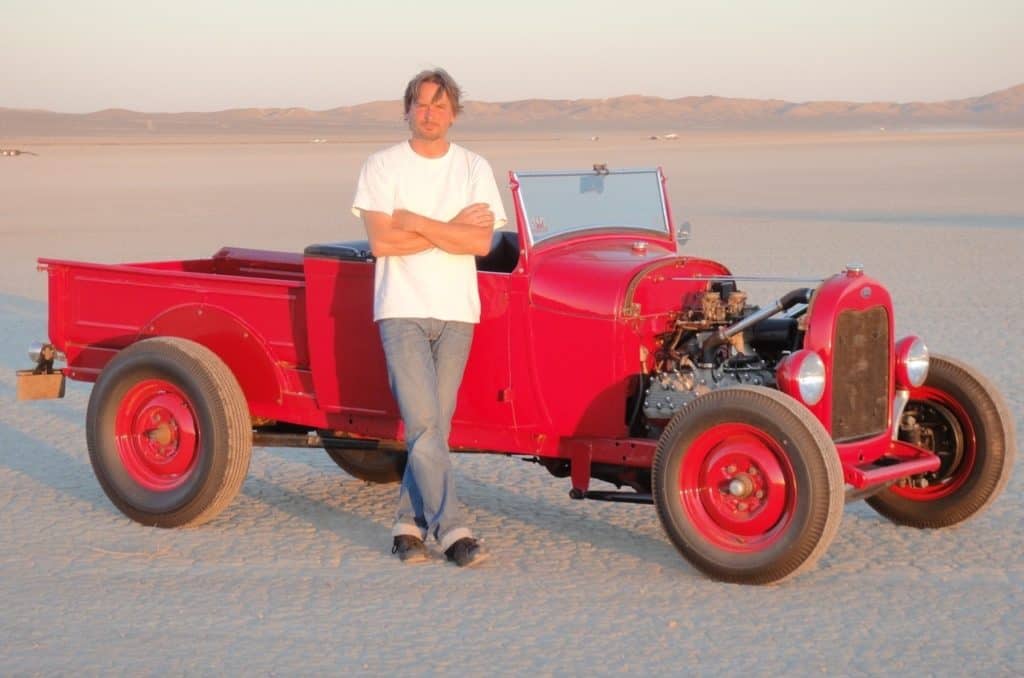
You can read more about David Steele at https://ahrf.com/about/our-team/
Marcus Bicknell helps in a PR and admin function with Rob Manson and the Del Monte Trophy Race Group – the cars from the Pebble Beach Road Races 1950-1956 – and drives the #15 1952 Streets Manning V8 Special here in this race meeting. marcus@bicknell.com