
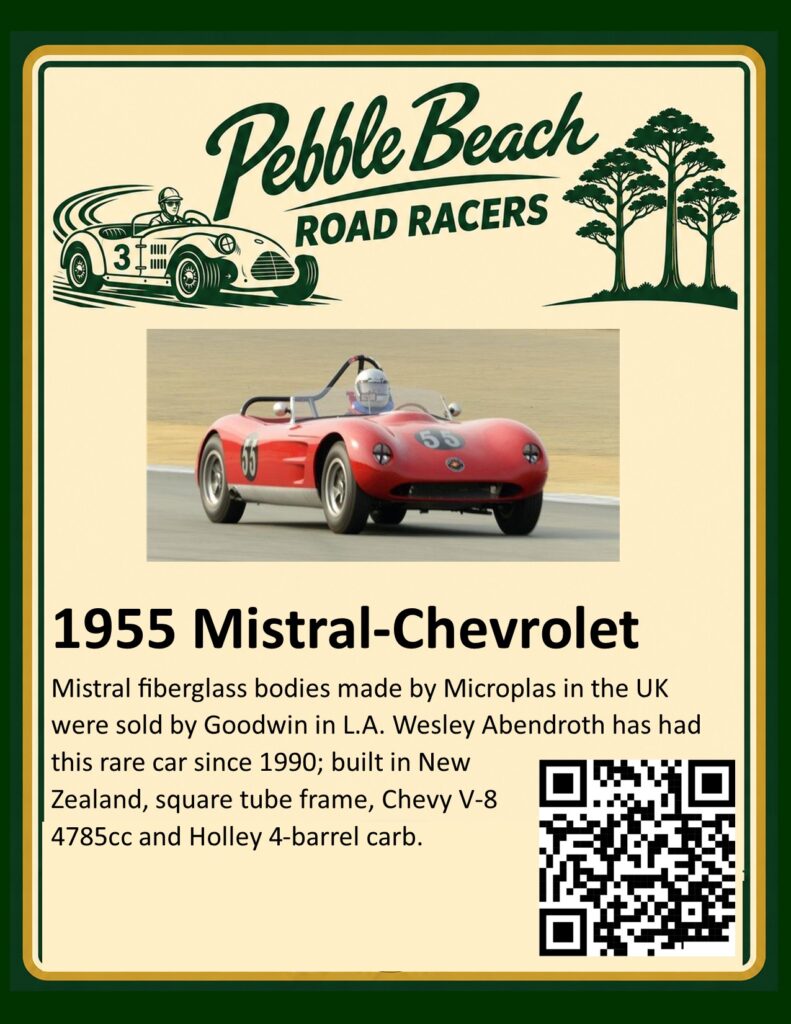
1955 Mistral-Chevrolet Sports Racer Chassis no. 34300786
Mistral fiberglass bodies made by Microplas in the UK were sold by Goodwin in L.A. Wesley Abendroth’s car was built in New Zealand with square tube frame, 283 Chevy V-8 4785cc, Holley 4-barrel and a Muncie gearbox.

Don’t feel bad if a “Mistral” rings no bells other than calling up an image of a 1960’s Maserati. But on an SCCA C/Modified grid in the Fifties and Sixties there were probably one or two Mistrals. It was a period where individual ingenuity reigned. There were many engines available. Transmissions were in nearly equal variety. And chassis? The dominant marques like Ferrari and Maserati used simple tube frames with independent front ends and semi-elliptic spring live rear axles. Fiberglass was the new aluminum: light and strong. Anyone could “splash” a female pattern off a sleek little hand-crafted European sports racing car (q.v., Bill Devin) and adjust it to fit a variety of chassis dimensions. Others could sketch out their own image of a sexy, simple, adaptable body and be in production in weeks. The concept flourished in Southern California where everyone thought they knew how to make fiberglass surfboards but the material’s adaptability and potential were not lost on the Old World.
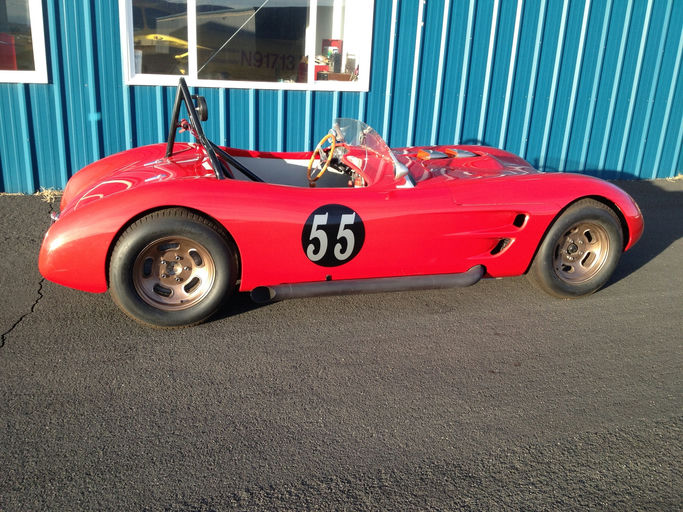
Enter Microplas. A group of British enthusiasts formed this venture in Uxbridge to build fiberglass sports-racing car bodies, some of them having gained experience building glass reinforced molded components for the British military in WWII. The first body, called Stiletto, was designed for the partners’ Austin Sevens and was quickly followed by the Bill Ashton-designed Mistral body for larger chassis. Mistral bodies were sold in the U.S. ($272 F.O.B. Los Angeles, $199 each in quantities of three or more) through Warren “Bud” Goodwin’s Sports Car Engineering. Goodwin eventually acquired molds from Microplas. Lightweight, adaptable and aerodynamically sleek, the Mistral proved to be popular, even being used by Frank Arciero during reconstruction of Tony Parravano’s Ferrari 375MM (s/n 0362AM) after it was comprehensively rolled by Jack McAfee at Bakersfield in 1955.

The Mistral-bodied Arciero Special was driven with some success by Dan Gurney during 1959, then by Skip Hudson and Bob Bondurant with a 4.2 litre Maserati Indy V-8. Meanwhile, Bud Goodwin’s Sports Car Engineering developed its own lightweight tube frame for the Mistral. Formed from a triangulated maze of brazed 1″ square tubing it encouraged creative racers’ imaginations.
From Los Angeles the Mistral body molds moved to Bob Blackburn in Christchurch, New Zealand where this car originated and where square tube frame construction resumed. It was found a few years ago as a derelict without a drivetrain and brought to the U.S. by the consignor, an aficionado of American specials, and became his “pandemic project” to restore. The very tentative verbal story behind it goes that it was built in NZ by an enthusiast. Taken to the track once, the builder concluded racing was not for him but it was used on the road for several years before being abandoned.

The brazed square tubing frame is period-appropriate in both design and construction. As even a cursory examination of the car itself and its photos shows, the workmanship, finishes, components and materials are of the highest quality. Power is provided by a 283 Chevy V-8 with 600 cfm Holley 4-barrel and solid lifter (not roller) camshaft with some 400 brake horsepower. A period-appropriate Muncie 4-speed takes power from the Hayes clutch and flywheel to a bespoke quick change live rear axle. The 15×6 inch Rocket wheels with Dunlop CR65 tires ride on coil-over Koni suspension from Performance Shock. Three Girling master cylinders with two remote reservoirs operate the dual-circuit brakes and clutch.
Modern safety equipment includes a fire suppression system, 5-point Simpson belts and a Harmon Racing 14 gallon fuel cell (certified through 2028). The frame was crack tested during restoration. Front suspension is Triumph with updated spindles, aluminum hubs, Girling calipers and Triumph rack and pinion steering. Rear brakes are drums complementing the 1,725 dry weight and 50.4/49.6% weight distribution.
Some of the text here comes from its last auction sale… https://www.bonhams.com/auction/28009/lot/202/1955-mistral-chevrolet-sports-racer-chassis-no-34300786