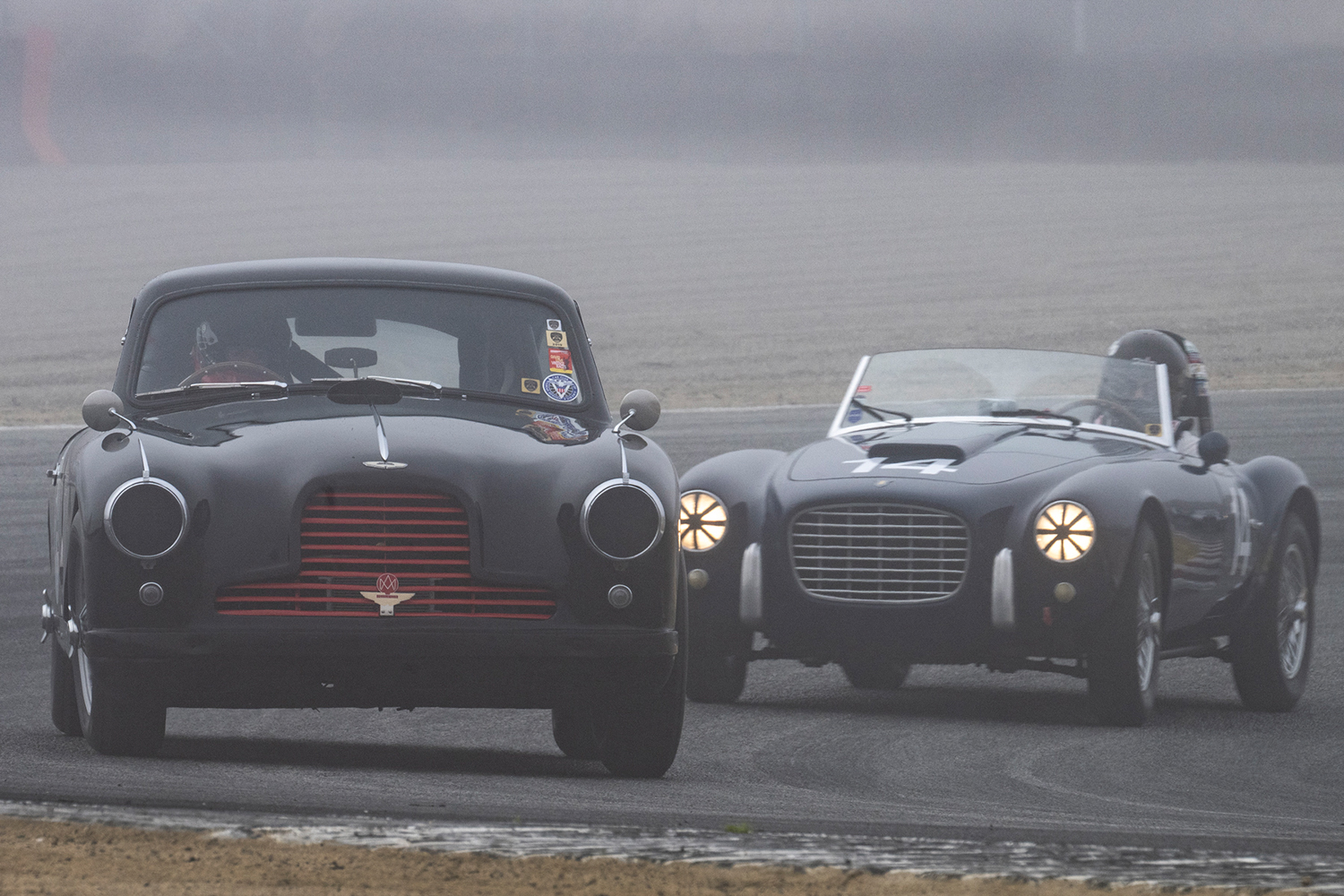
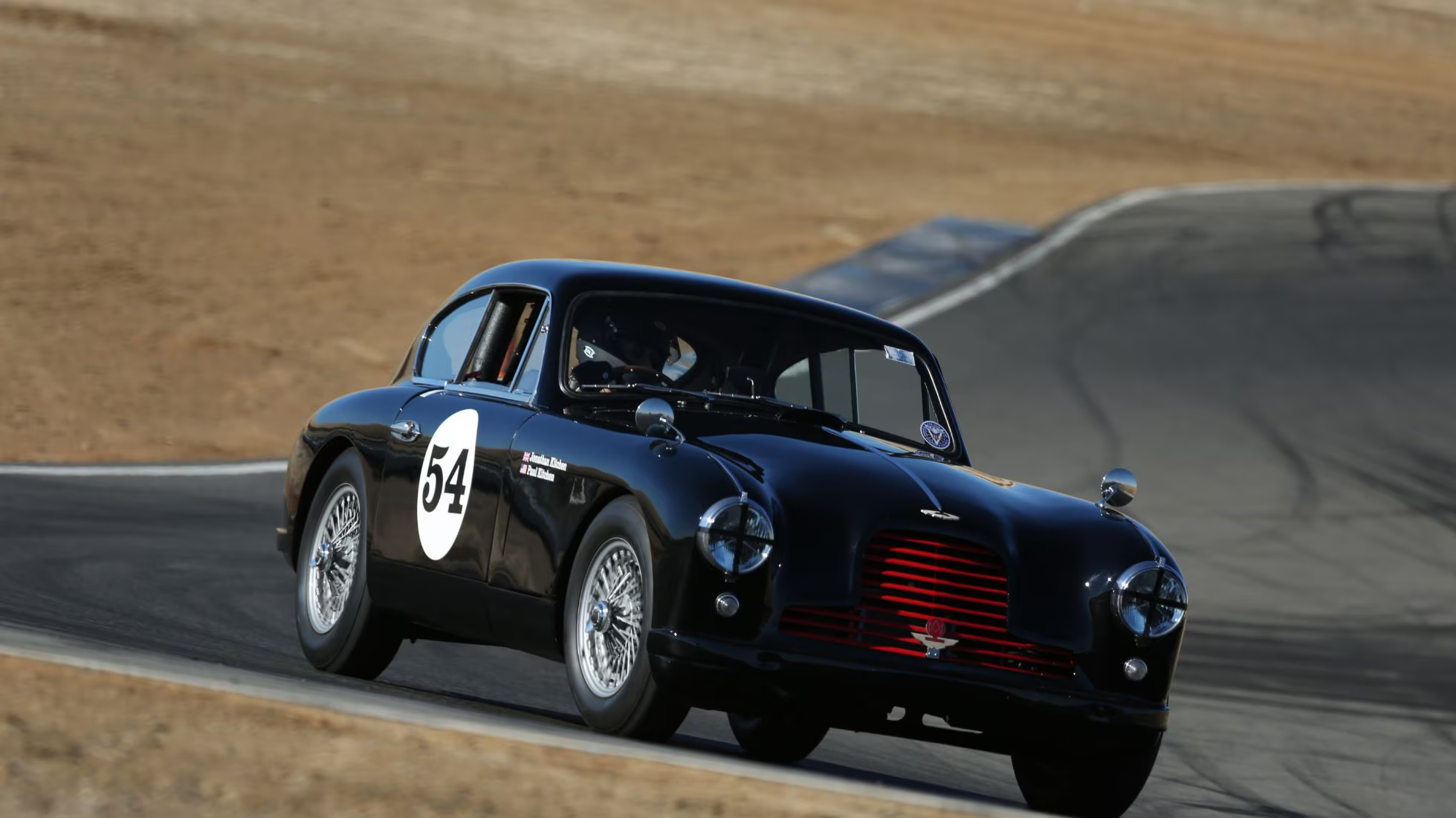
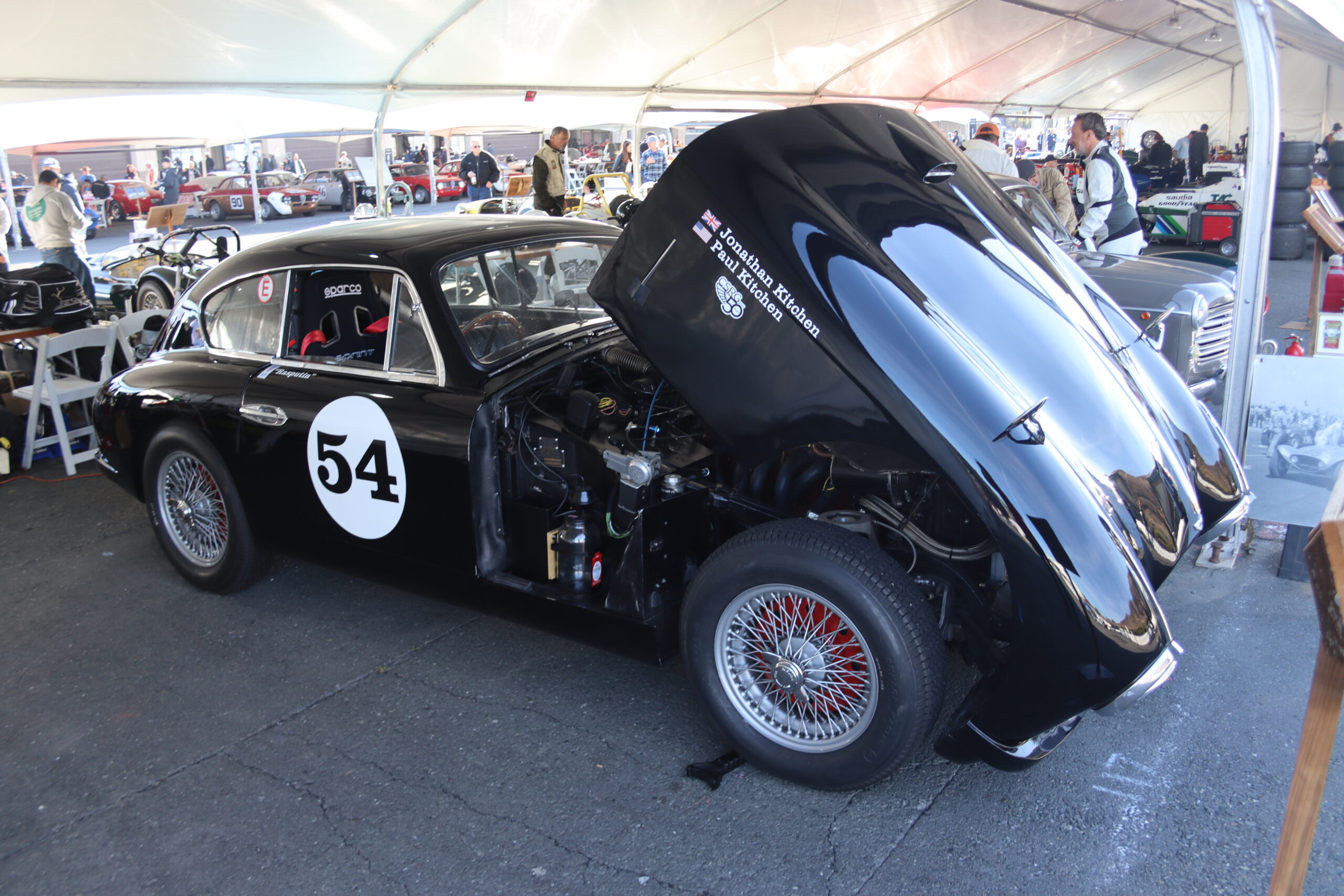
Jonathan and Paul Kitchen – #54 1954 Aston Martin DB 2/4 Mk1 “Rasputin”

Aston Martin made 463 DB2/4 Mk1 hatchbacks between 1953 and 1955. This one, chassis number LML841, was delivered on November 11, 1954. Five years later it went back to the factory and was fitted with an upgraded 3-liter (2,922cc) engine and a new gearbox, producing 140 hp and a top speed of 120 mph. In the late ‘50s and early ‘60s it was raced in BRDC events at Silverstone, Snetterton and various other English circuits and on the RAC Rally.

The car was imported into the US in the early 1970s and raced in a number of local events in the Midwest such as the Candee Farm Sprint and the Mid-Ohio Time Trials. In the early 1990s it was sold to noted race car driver Pierre Honegger who raced the car extensively. In 2000 Jim Hazen, then Chair of the Aston Martin Owners Club Section East, bought the car and christened it “Rasputin,” a name that has stuck with the car ever since. “Rasputin” is featured in numerous Aston Martin publications. It has been a frequent competitor at various VSCCA events, including the Lime Rock Fall Festival, and under its current owners, Jonathan Kitchen and his son Paul, it has been restored and raced at various CSRG events, the Sonoma Festival of Speed, The Rolex Monterey Motorsport Reunion and the Velocity Invitational.
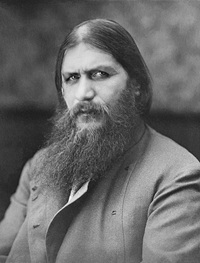
“Rasputin” is not just a popular song by Boney M… Grigori Rasputin (1869-1916) was a Russian mystic and faith healer, and was known for scandalous behavior, including excessive drinking and alleged sexual licentiousness, which earned him the nickname “Rasputin,” meaning “debauched one. One fully restored Aston Martin DB2/4 was once owned by Prince Felix Yusupov, one of the assassins of the historical Grigori Rasputin.
The Aston Martin DB2/4 is a grand tourer produced by Aston Martin from 1953 until 1957. It was available as a 2+2 hatchback saloon, drophead coupé (DHC) and 2-seat fixed-head coupé. The DB2/4 was based on the DB2, which it replaced. The key change was the addition of two small rear seats and an opening rear tailgate giving access to the luggage space. Other changes included a single-piece windscreen, larger bumpers, and repositioned headlights.
The Aston Martin DB2/4 – a thoroughbred sports racing car…

The Lagonda straight-6 engine, designated the VB6E, was initially the same dual overhead cam straight-6 designed by W. O. Bentley and used in the Vantage version of the DB2. Displacement was 2.6 L (2,580 cc/157 in3), giving 125 hp (93 kW). In September 1953 the Saloon received a 140 hp (104 kW) 2.9 L (2,922 cc/178 in3) VB6J variant, followed by the Drophead in April 1954. Maximum speed was raised to 120 mph (193 km/h). Of the 565 Mark I models produced, 102 were Drophead Coupés.
A 2.9 litre DB2/4 tested by British magazine The Motor in 1954 had a top speed of 118.5 mph (190.7 km/h) and accelerated from 0-60 mph (97 km/h) in 10.5 seconds. A fuel consumption of 23.0 miles per imperial gallon (12.3 L/100 km; 19.2 mpg‑US) was recorded. The test car cost £2621 including taxes. Three works cars were prepared for the 1955 Monte Carlo Rally and two for the Mille Miglia. A DB2/4 Mk I Drophead Coupé appeared in the 1963 Alfred Hitchcock film The Birds.
| Manufacturer | Aston Martin |
| Production 1953–1957 | 764 produced |
| Designer | Frank Feeley |
| Body Class | Grand tourer |
| Body style | 2+2 hatchback 2-seat drophead 2-seat fixed head |
| Engine | 2.6 L Lagonda I6 or 2.9 L Lagonda I6 |
| Wheelbase | 99 in (2,515 mm) |
| Length | 169.5 in (4,305 mm) |
| Width | 65 in (1,651 mm) |
| Height | 53.5 in (1,359 mm) |
| Predecessor | Aston Martin DB2 |
| Successor | Aston Martin DB Mark III |
Recent market value of the type… 1955 Aston Martin DB 2/4 Mk I Saloon – Mille Miglia Registro – £206,474 0- https://www.classic-trader.com/uk/cars/listing/aston-martin/db-2-4/db-2-4-mk-i/1955/443058
Track test… https://www.youtube.com/watch?v=7ys8wLAGEmY Sam Hancock