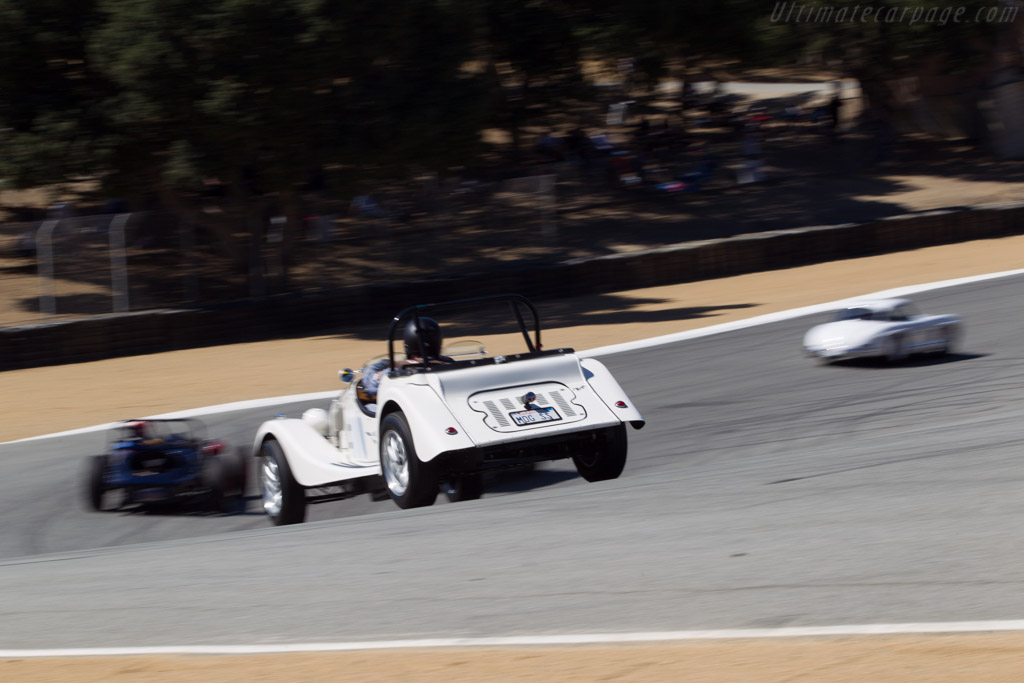
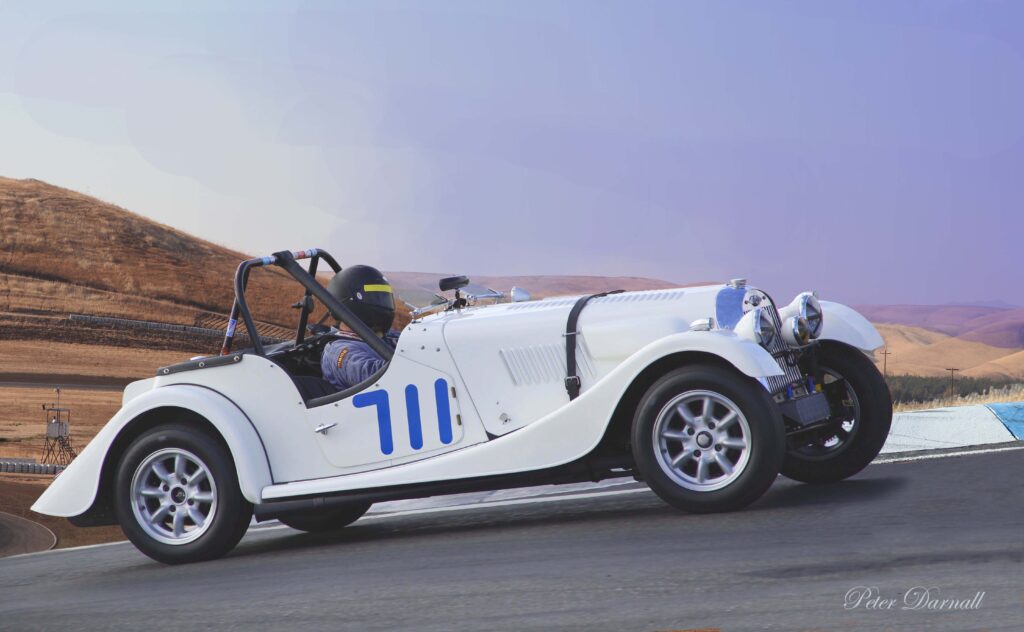
Doug Sallen’s white Morgan Plus 4 – Chassis: 2461 – often ran with race No.711. He has been an ardent racer and supporter of the Del Monte Trophy Race Group for decades.
1952 Morgan Plus 4 owned by Doug Sallen and he raced often, for example in the Rolex Monterey Motorsports Reunion in 2016 at Laguna Seca. The car has a documented history, has received mechanical overhauls, and has a known competition history. It is a “flat rad” version of the 1952 Morgan Plus 4, named for its flat radiator design, which was used only until 1953. Only 117 “flat rad” two-seater models with the TR2 engine were produced.
Engine and Transmission: It is powered by a Triumph TR2 engine with a 2.1-liter displacement, mated to a 4-speed Moss gearbox.Performance: The 100bhp engine could accelerate the lightweight car (790kg) to 60 mph in 9.6 seconds and reach a top speed of just under 105 mph.History: The car has a rich history, including a significant engine overhaul in 2000 and a complete chassis-up restoration by TT Workshops in 2007-2008. It also has a notable competition history in events like the RAC International Rally

The story of the Morgan Plus 4. Peter Darnall writes in 2020 “There was a time, a long time ago, when a sports car was just that—a car intended for the sport of driving. You could drop the windshield, tape the headlights, and have a go at the racetrack. The car you ran in competition was also your daily driver, but you probably did not share your exploits on the track with your insurance agent!
The Morgan Motor Company builds machines for the hardcore enthusiast. Change comes reluctantly to the craftsmen at Malvern Link; the folks at Morgan were never interested in creating stylish transportation for Mom and the kids. Henry Frederick Stanley Morgan, known as HFS to his friends, built his first motor vehicle, a simple three-wheeled conveyance, and entered his creation in the London to Exeter Trials in 1910. His machine won a gold medal and Morgans have been associated with motor sports ever since. Metaphorically speaking, it is in their DNA.
“Due to a loophole in British law, three-wheeled vehicles were classified as motorcycles and qualified for a lower tax rate than automobiles. Cyclecars with mercilessly tweaked engines became a way to go fast without spending a lot of money, and Morgans were created to do just that. Reflecting its motorcycle heritage, the throttle mechanism on a Morgan trike is a lever device which rotates with the steering wheel. Obviously, one must learn to allow for this quirk when slowing or stopping the vehicle. Competitive racers addressed this issue with a rubber band cut from an inner tube which was put on one’s arm. At the start of a race, the throttle lever was opened wide and the rubber band was slipped over the lever to lock it in position. The cornering technique on a racing “Mog” was not for the faint-hearted. The passenger was expected to clamber about the narrow cockpit extending himself out as far as possible from the careering vehicle to offset the tendency of the machine to swap ends and roll over.
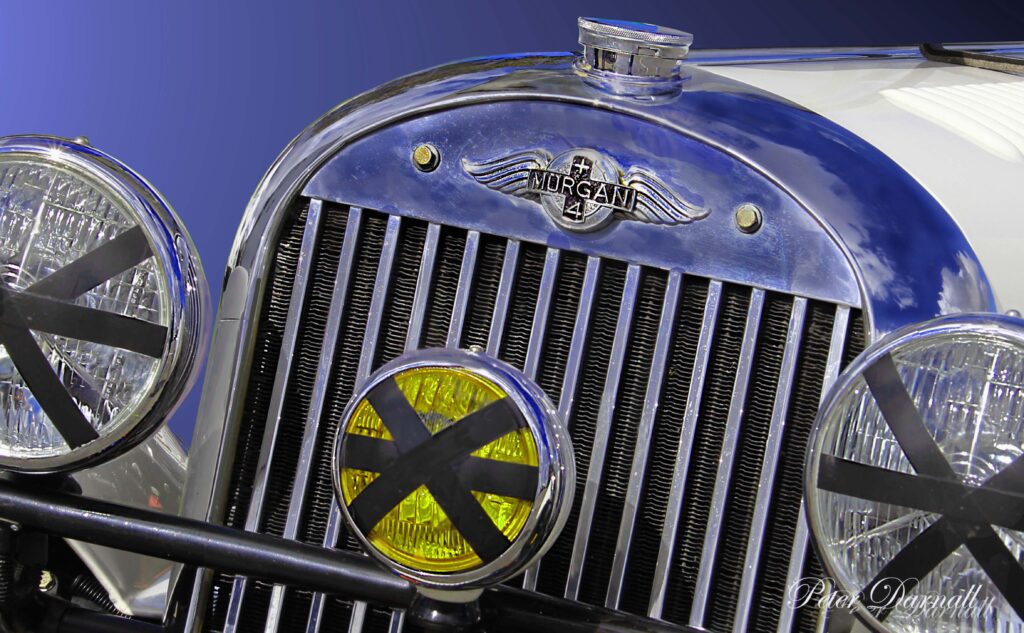
“Bowing to public demand, Morgan added a new sports machine in 1936. The newcomer was a four-wheeled sports car labeled the 4/4 to distinguish it from its three-wheeled brethren. Following company tradition, this machine was offered without significant change until after the Second World War when the company providing the headlight units went out of business. The day of the vertical radiator and the separate headlights was over. The restyled front end would incorporate a slanted radiator with the headlights faired into the bodywork.
The caterwauling of the “flat rad” traditionalists over the streamlined front end continues to this day.”