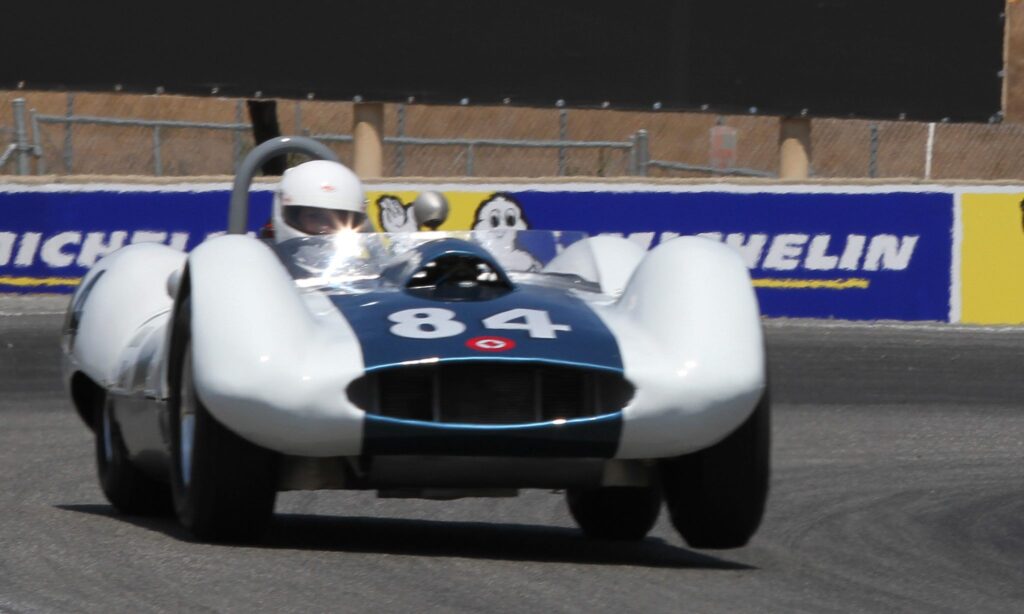
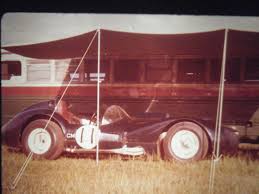
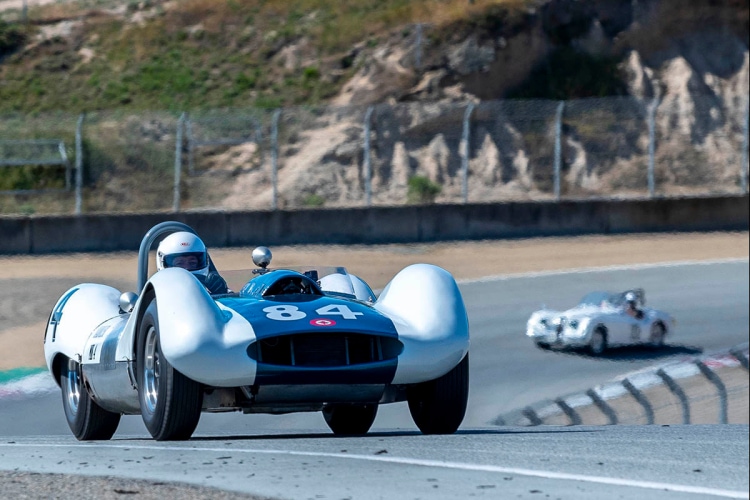
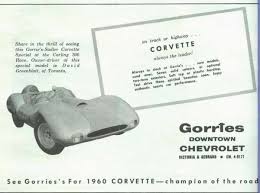
Greg Meyer – 1959 Sadler Mk.4 Chevrolet 327 V8
The Del Monte Trophy Race Group (Pebble Beach cars, see the definition at https://dmtrg.com/the-definition/) welcomes other cars to the grid as the race meeting organisers decide. In 2023 and 2024 the Rolex Monterey Motorsports Reunion pitted us against later cars, preferably front-engined and with disk brakes. One of the most exciting to race against is the 2023 RMMR double winner Greg Meyer in his 1959 Sadler so for the sake of the bigger picture we have pleasure in featuring this car on our web site (but not in the register of DMTRG cars (https://dmtrg.com/cars_list/). The car and driver are so quick that it would be discourteous to ignore them.
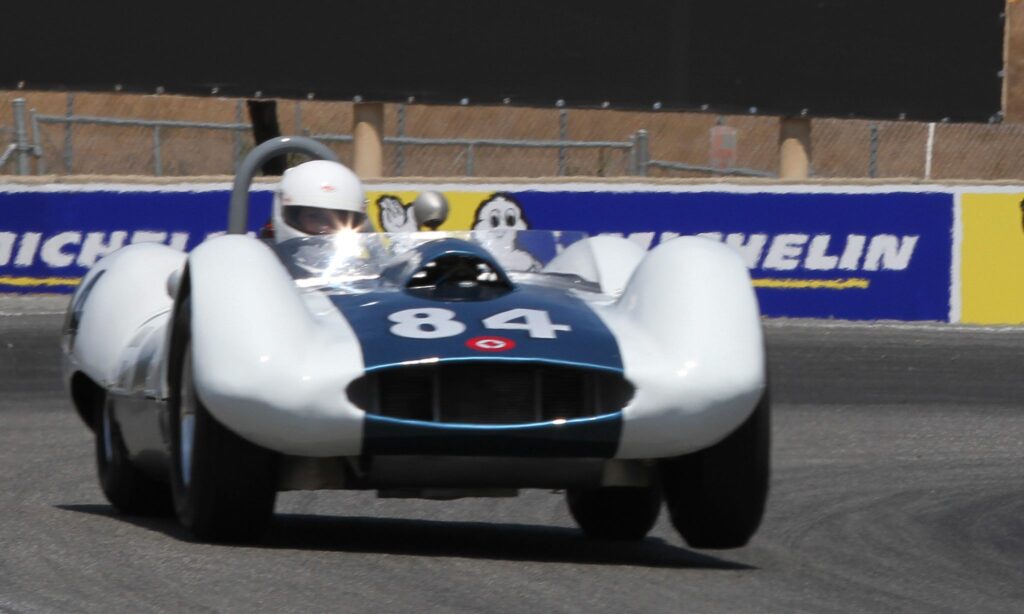
With thanks to Tam MacPartland for the photo
First, an excerpt from my report on the 2023 RMMR. “As in Race 1, the Pebble Beach Del Monte cars are joined in Group 12 by later models. Under blue Californian skies and ideal conditions, our 30 period race cars took to the track on the meeting’s last day, the Saturday, for the second time. Ah ha! In the pre-race interview in the collecting area Al Arciero asks the interviewer to tell Greg to slow down a bit in the race. Greg Meyer, in turn, asks the interviewer to tell Al to speed up! Honour among thieves. As Henry Ford remarked, “Auto racing began five minutes after the second car was built.” Al Arciero sitting in his 1958 Knobbly recounts “When I got up this morning I had to take 4 Advils. It’s hard work. It’s hot. The exhaust pipes are by my feet. You really have to hold on; it has a mind of its own”. Greg’s remarks are similar; “5.6 inches of rubber; that’s not a lot of contact patch to control a car of this power. But where’s the best seat in the house to watch the races; sitting right here”.
https://dmtrg.com/laguna-seca-aug-19-2023-2/ and
https://dmtrg.com/laguna-seca-aug-18-2023/
About the Sadler race cars. The Sadler MK4 & the Sadler Meyer special were built at the same time in 1959 by Bill Sadler – both were previously owned by vintage racer Greg Meyer (not related to John Von Meyer). Greg Meyer still owns & drives the Sadler MK4 and has competed in many RMMR and other historic meetings. The Sadler MK4 won the Monterey Reunion in 2018 & 2019 with Bill Sadler in attendance at age 87 (Holly Dimple, Facebook). If you can refer us to more about Greg Meyer we would be happy to update this piece.
About Bill Sadler. Canadian-born Bill Sadler built many big-engine sports racers, Specials, and Formula cars during the 1950s. His first creation was the MK1, which was soon followed by the MK2, MK3, MK4, and lastly the MK5. The MK1 had a ladder frame and an aluminum body which was later replaced with a fiberglass body that was more attractive. Power was from a Triumph TR2 engine fitted with a fuel-injection system of Sadler’s design. In 1955, the engine was replaced after throwing a rod with a Chevrolet V8 engine that displaced 265 cubic inches. It had two four-barrel carburetors and produced around 200 horsepower which was sent to the rear wheels via the Triumph gearbox assembly.
The V8 engine was a monster within the MK1, so Sadler set out to design and build a car better suited to this raw power. The MK2 consisted of a ladder tubular frame that featured a leaf spring suspension in the front and a low-pivot swing axle setup in the rear. A 1934 preselector gearbox and drum brakes were installed with hopes of taming the V8 engine. The MK1 fiber-glass body was removed and placed on the MK2. Later in the car’s history, the engine was removed and replaced with a 283 cubic-inch unit which had its bored out to 300 ci.
He brought the car over to Europe and pitted it against the competitive European makes, occasionally outpacing the rest of the pack, such as at the Brighton Speed Trials, where his MKII proved to be the fastest. Upon his return to Canada, Sadler removed the front drum brakes and replaced them with discs. Modifications were made to the engine and aluminum body panels replaced the old body. He continued to race the MKII during the 1958 season, winning at the Watkins Glen Classic and managing to run near the front in many other races.
For the following season, Sadler found sponsorship through Earl Nisonger, the president of an auto parts company. With this new found funding, Sadler began building a new racer, one with a space frame chassis that could sit lower to the ground. Disc brakes with aluminum calipers were on all four corners of the car. The suspension was comprised of a low-pivot swing axle in the rear and front A-arms with coil-over Koni shocks. In the engine bay was a Chevrolet 327 cubic-inch engine breathing through a Hillborn fuel-injection system and producing a very heft 340 horsepower. A Borg-Warner T-10 four-speed gearbox was used to handle this power. The Sadler MK3 was a sophisticated and modern machine but it failed to acquire the expected results. The MK3 was followed by the MK4 which was very similar in many ways. Both rested on an 86-inch wheelbase, both had an aluminum body, Girling disc brakes, and weighed just under 1700 pounds. The MK3 had a swing axle rear setup while the MK4 was given a live axle. The MK4 was intended to become a series production machine but only one was ever created. For the first time in the MK Sadler Series, the MK5 broke the string of ‘one example created.’ There were two examples of the MK5 created, featuring many changes over its predecessors. The most dramatic was its mid-engine setup resting in a space-frame chassis and clothed in an attractive aluminum body. A Halibrand quick-change rear end and two-speed transaxle were used, along with Girling disc brakes on all four corners.
The two cars were used during the 1961 season. When they were not plagued by reliability and teething problems, they proved to be rather quick. Sadler abruptly left the team after a disagreement with the sponsor, Comstock Construction. Only one of the two MK5 examples exists in modern times, as one was destroyed in a fire.
https://en.wikipedia.org/wiki/Bill_Sadler_(engineer).
Marcus Bicknell 22 July 2024