
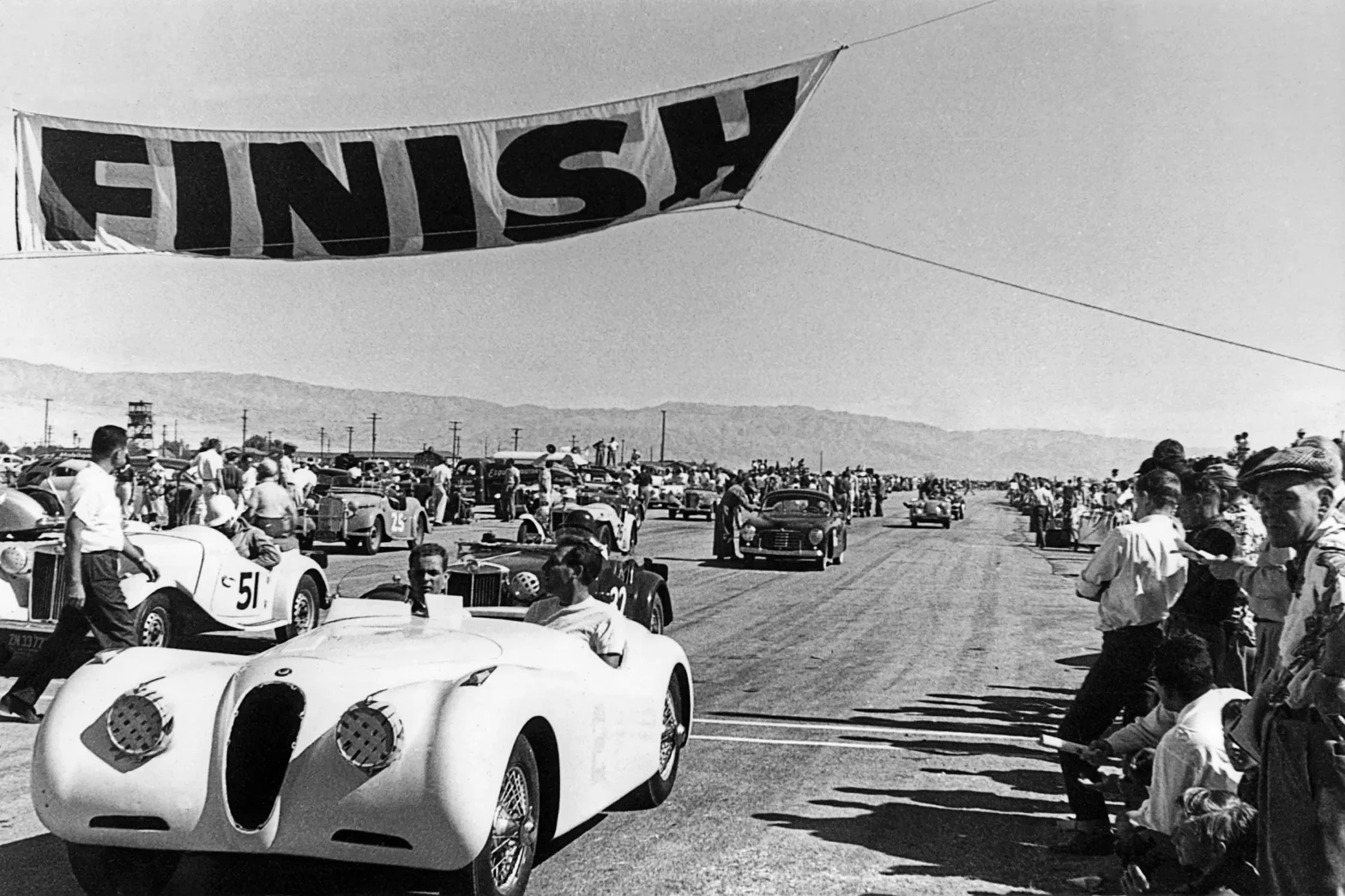
The extraordinary 1951 Jaguar XK120 Works Lightweight LT3 Jaguar with Abbey Panels – an Open Two Seater chassis number 660741 – was acquired in 2026 by Jim and Lisa Hendrix and prepared for showing at the Pebble Beach Concours d’Elegance on August 16, 2026. The car is steeped in race history.
Engine no. unnumbered block,
Cylinder head E-1012-8 (ex C-type)
3,442cc DOHC Inline 6-Cylinder Engine, Twin SU carburetors, 180bhp at 5,200rpm
4-Speed Manual Transmission, Independent Front Suspension, Rear Semi-Elliptical Leaf Springs, 4-Wheel Hydraulic Drum Brakes
One of only 3 Works Lightweight XK120s built for potential use at Le Mans
Purchased new by Charles Hornburg and campaigned by him in USA
Raced by Phil Hill, Sherwood Johnson and John von Neumann for Hornburg

Recorded on the Del Monte Trophy Race Group Register at No.66 (https://dmtrg.com/the-definition/)
For an American collector – and for anyone who reveres Jaguar’s golden era – few cars equal the allure of a factory-built racing XK120 driven in period by Phil Hill: a man who would become America’s first Formula One World Champion (1961) and three – time winner of the 24 Hours of Le Mans.
In 1951 Jaguar prepared to return to La Sarthe with a bold new weapon, the space-framed C-Type. But William Lyons, ever pragmatic, would not entrust his Le Mans ambitions to a single plan. As insurance, he authorized a trio of specialized XK120 racers-lighter, leaner, and built with quiet urgency- should the C-Types fail to be ready. They were known simply as LT1, LT2, LT3.
Though rooted in modified XK120 running gear, the rare factory LT cars wore something more exotic: ultra-lightweight aluminum bodies crafted by Abbey Panels, shaped over a Superleggera-style framework. Only LT2 and LT3 were completed, and when it became clear the C-Types would make the race, the LT pair sat mothballed at Browns Lane, their destiny paused.
Then fate intervened. Charles Hornburg, Jaguar’s West Coast distributor, saw the sleeping potential in these two extraordinary machines. With production C-Types still some distance away, he struck a deal with Lyons and brought LT2 and LT3 to America in August 1951, determined to prove Jaguar’s strength on U.S. circuits.
For that task, Hornburg selected two gifted Californians: an ambitious young driver already making waves in XK120 competition-Phil Hill and Sherwood Johnston. LT3 debuted at Elkhart Lake on August 26, 1951, where Hill guided it to 3rd overall and 1st in class, beginning a story as compelling today as it was in that first season of promise. LT3’s fourth race and first of 1952 took place at the Pebble Beach Road Race leading to a 5th overall finish.
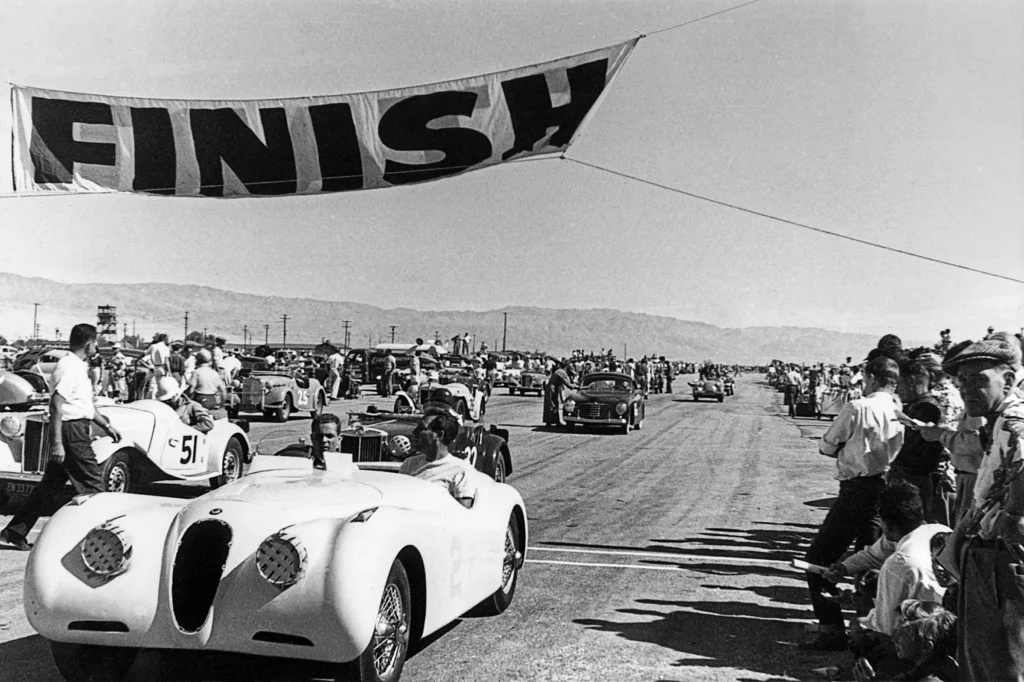
We look forward to seeing the faithfully restored car at the Pebble Beach Concours d’Elegance in August 2026; two weeks before the event Jim and Lisa wrote to us as follows.
“As the current caretakers of our car that has continuous unbroken history, we are taking care to be focused on getting it right. Attention to detail is everything with this restoration. We have restored LT3 to the look as it raced at the Pebble Beach Road Races in 1952, also shown on the 1953 advertising poster for the Pebble Beach Road Races. The colors and the numbers on LT3 are from the Pebble Beach April 1952 race as Phil Hill drove it. The evolution of the car has also been a focus. As you know from the Bonham’s sale details you posted, the car has XKC 010’s cylinder head E 1012-8. We have spent considerable time researching the specifications of not only this head but the other mechanical details as well. We want the car to be ‘on the lawn’ correct in every way possible.
“LT3 has been a ground up, body off, nut and bolt restoration. An interesting point is that the body was designed to lift off and that is what took place with just a couple of guys with no other mechanical assistance, it’s very light. When we say nuts and bolts, we have gone to the extent to utilize original “Bees Brand” nuts and bolts on the chassis by reusing only good ones that it had originally and have sourced the sizes needed for replacements any way we could find them. This detailed execution goes on further with the hours of researching originality in every way possible with original Jaguar documents that we have accumulated over the years in the form of factory manuals, factory specification and factory service documentation. We are on the final push to finish the small items with testing along the way to make sure we are ready given that this is a fresh restoration.
“Here are some originality details, it has its nearly all its original ‘Lightweight’ alloy skin. The only exception is when ‘repaired in period’ or during the restoration where there was no other option. We had a metallurgist come to analyze the structure so that any metal we needed for repair was the same as what it had originally. The analysis confirmed it is an alloy that is made up of magnesium, aluminum and also titanium. It has nearly as much sheet metal on the floorboards and under the car as on the exterior. The unseen structure of Superleggera tube frame support construction under the exterior skin can be seen in strategic places that can easily be shown. The under panels were used to block off speed robbing obstructions from below to give it a smooth flow with the goal to limit turbulence. I don’t know if you would call it ground effects, but it was definitely a focus for the designer Malcolm Sayer. He referred to himself as an Aerodynamicist. 1
“LT3 has had an interesting ownership life and spent decades in St. Louis, where we live. The longest owner was the last owner before us, Tom Hendricks (no relation as our name ends in an “x”), but of all the previous owners to Tom LT3 spent more time of its racing life in St. Louis than anywhere else.”
See also significant history detail at https://cars.bonhams.com/auction/28010/lot/173/1951-jaguar-xk120-lt3-works-lightweight-sports-racer-lt3-chassis-no-660741-engine-no-unnumbered-block-cylinder-head-e-1012-8-ex-c-type/
- Malcolm Sayer (1916–1970) was a pioneering automotive aerodynamicist and mathematician who notably loathed being called a ‘stylist’. He mathematically defined the voluptuous curves of Jaguar’s 1950s and 60s racing and road cars, famously treating metal panels like aircraft wings to minimize drag. His unorthodox, purely mathematical methodology relied on logarithms and complex curve formulas rather than traditional sketching. A former aircraft engineer for the Bristol Aeroplane Company during World War II, Sayer brought aerodynamic precision and lightweight construction methods directly to the automotive world. His celebrated achievements at Jaguar include:
* Jaguar C-Type (1951): His first major contribution, mathematically optimized for high-speed racing, which won the Le Mans 24-hour race in 1951 and 1953.
* Jaguar D-Type (1954): Utilized advanced aircraft-inspired monocoque construction and aerodynamics, dominating Le Mans from 1955 to 1957.
* Jaguar E-Type (1961): Considered one of the most beautiful cars in the world, every inch of its body was meticulously calculated by Sayer for aerodynamic efficiency.
* XJ13 & XJS: Developed the aerodynamics for the XJ13 prototype, and laid the mathematical groundwork for the XJS Grand Tourer before his sudden death in 1970 ↩︎