
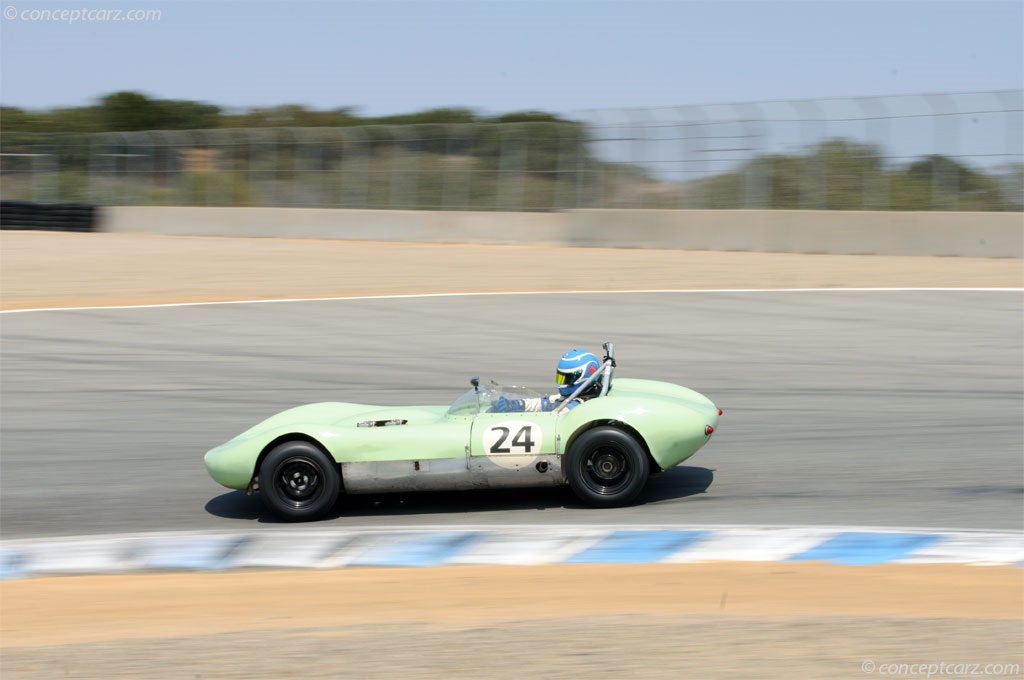
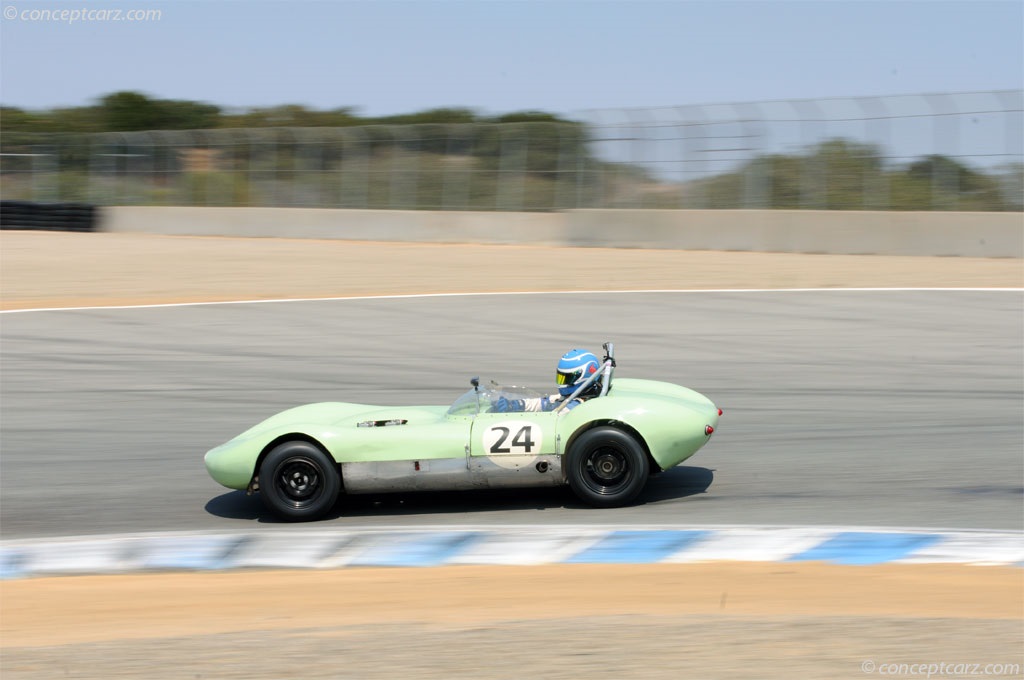
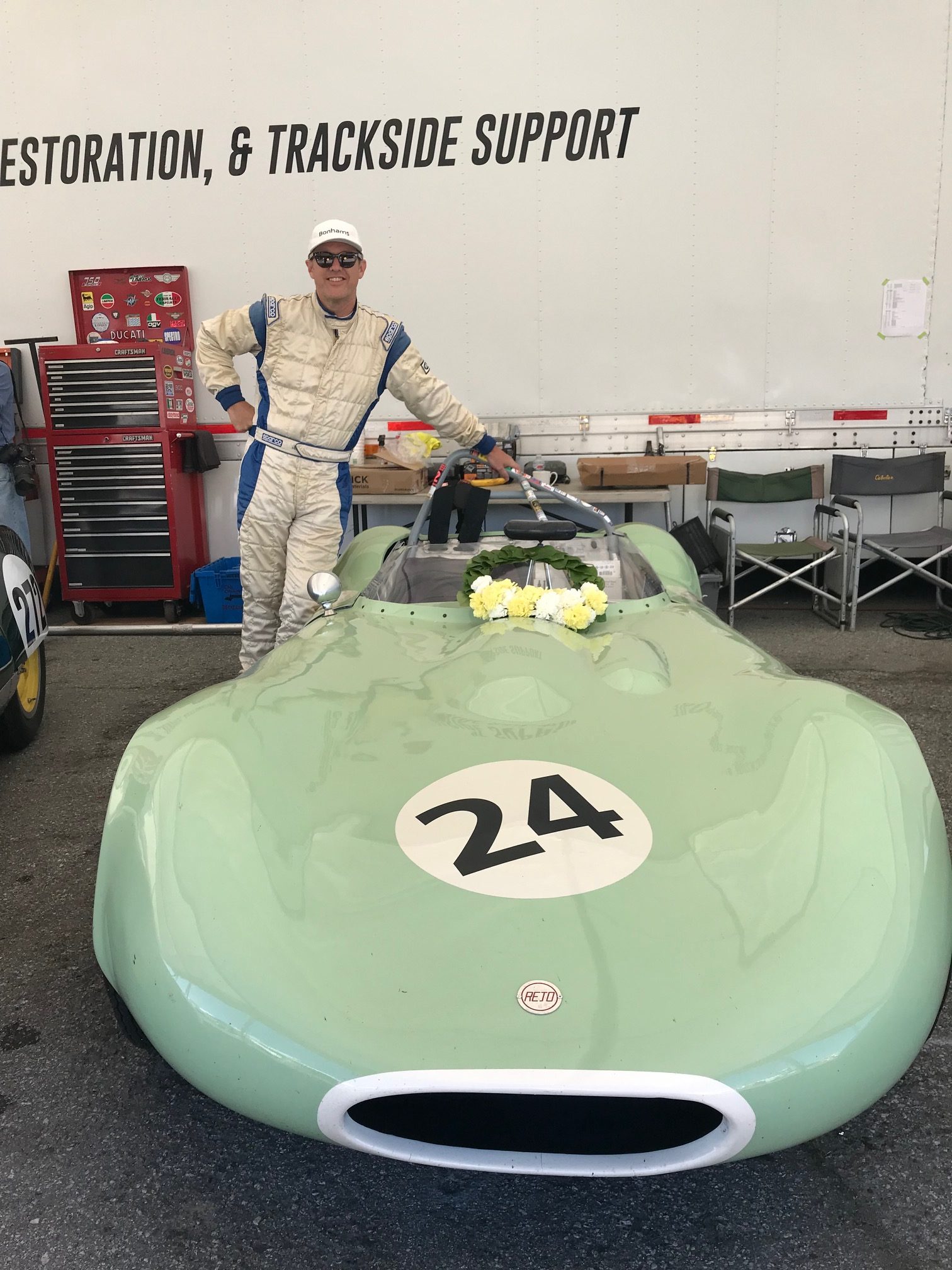
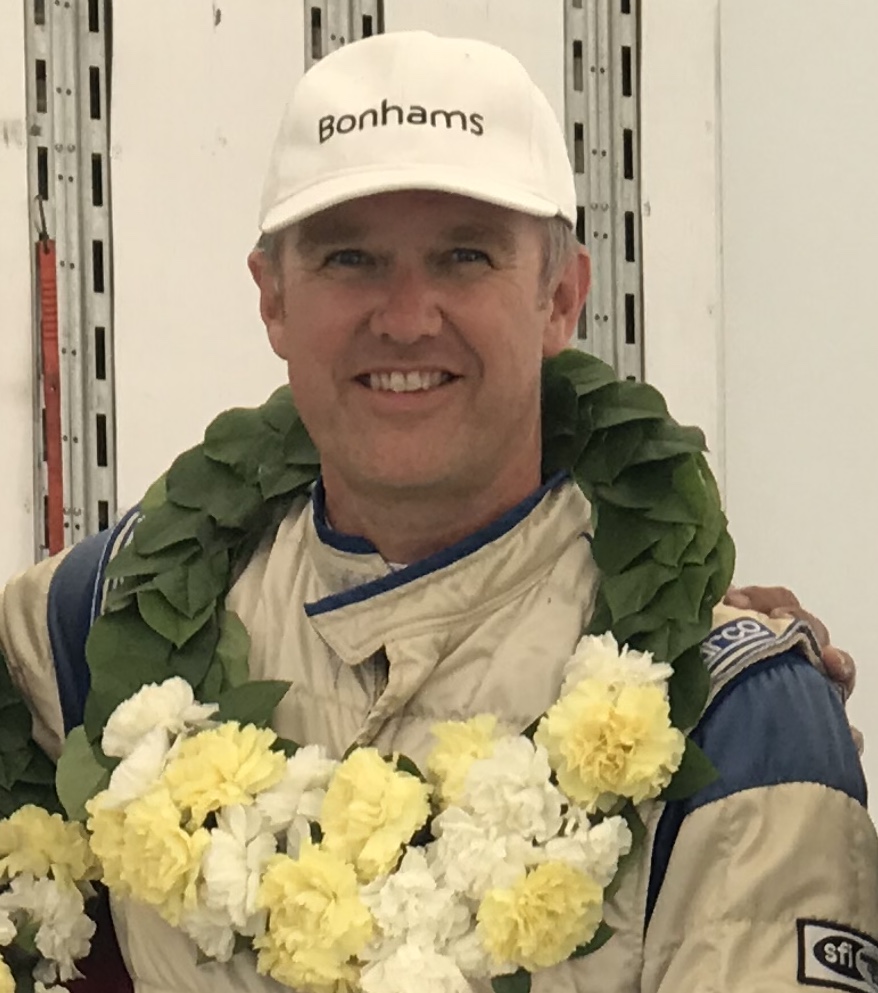
At the Rolex Monterey Motorsports Reunion 2024 at Laguna Seca, Race 1 of the Group 2 cars, that’s the 1946-1960 Front-engine GT, sports racers and American Specials, was won by #24 Mark Hamilton Peters in the Osborne family’s light green 1500cc #24 1959 Rejo Mk VI chassis 8132. Mark Osborne drive it to 10th place in Race 2. Great job by a small-engined car. Mark Osborne is Global Director of Motorsport at Bonhams auctioneers.
All web references to this car including photos of the #24 light green call it the MkIV. The programme MkVI was typo. Mark Osborne has confirmed for us Sept 3, 2024 that this car is a MkIV… Mark 4.
At the 2024 RMMR this month, the Rejo was listed in the entries for the John Morton Trophy Group 3 which is for small displacement production cars. As a Special or limited production sports racer we suppose that it was originally mis-classed and thus moved into our Briggs S. Cunningham group 2. Mark Hamilton Peters (MHP to his intimates) is a pro driver who has the privilege of driving many great cars in race condition. Rob Manson in the dark blue Baldwin Mercury Special #77c reports “MHP went by me like a rocket on Friday. I was dicing with Mark Osborne on Saturday; he was half a second quicker, best lap time, and finished ahead.”
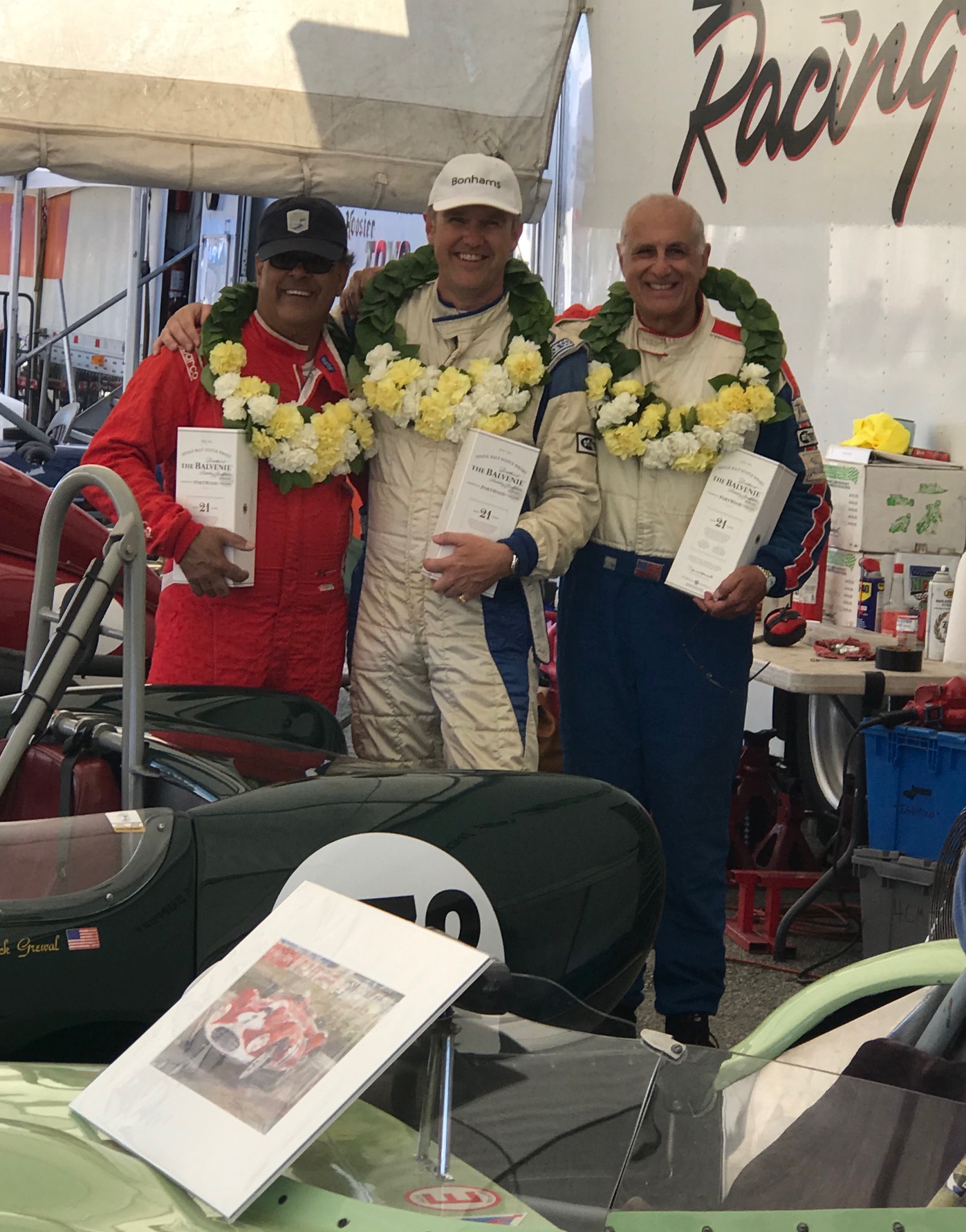
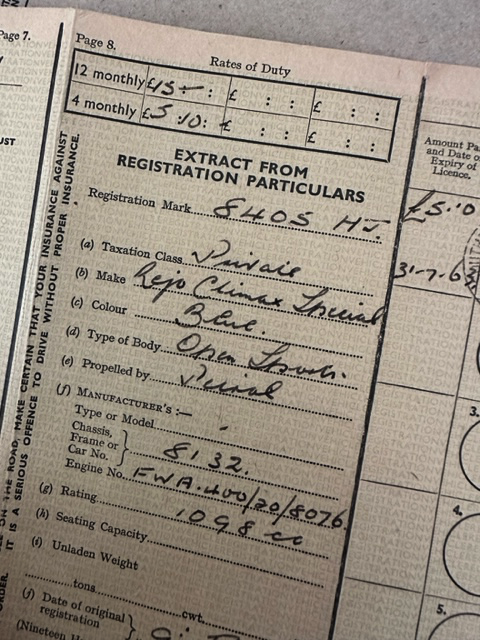
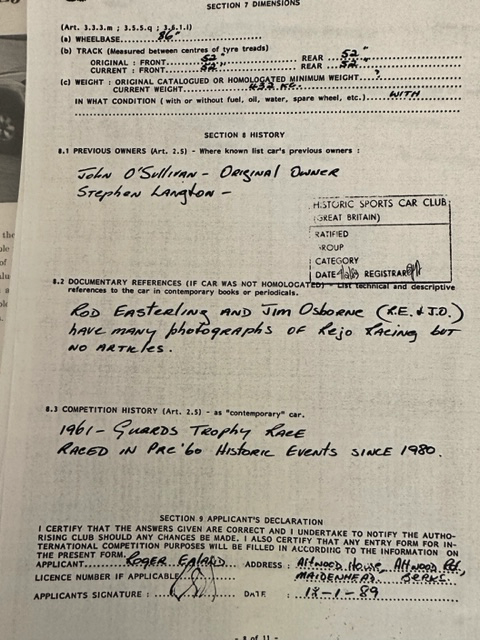
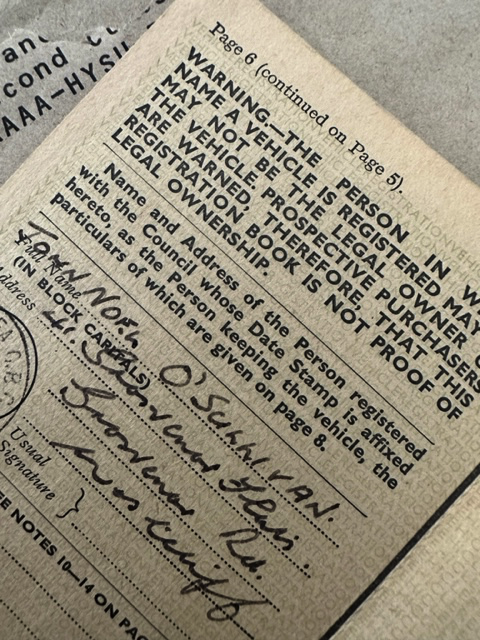
Mark Osborne informs us “The Rejo is fully independent, front discs, rear drums, Gemini Jr. diff. 1440cc Ford Pre-crossflow, 145hp, revs to 7500. The car is registered 8405 HJ, and can be seen racing with this number on google searches. The chassis number 8132 was issued in 1959. These 8000 series numbers were issued to ‘kit cars’. 8132 is stamped (faintly) on a driver’s side front tube. Known as a ‘Rejo Climax Special’ it initially ran with a Coventry Climax FWA (no. FWA.400/20/8076) then a 1100cc Cosworth Junior engine, then a Pre-Crossflow 1440cc I believe. All owners are accounted for from John O’Sullivan, through Roger Ealand (also mentioned in the article) to me. Winner of the HRRDC Championship in 2019, it was runner up in 2018. (images supplied) Michael Kaleel 2nd place, Nick Grewal 3rd. Great buddies of mine. Winner: Ken Miles award, Rolex Monterey Motorsport Reunion 2019
What do we know about Rejo cars in general?
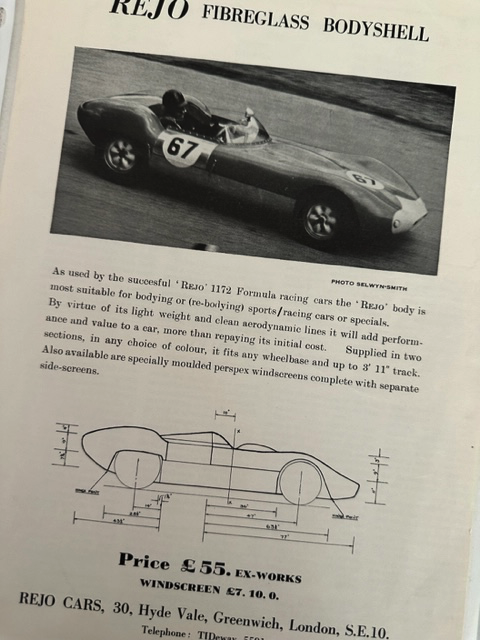
The name ‘REJO’ is comprised of the initials of Rod Easterling and Jim Osborn. The two individuals met while amateur racing. After years of racing and tuning, the two decided to build a car of their own. Using the dimensions and design of a Lotus 6 as inspiration, and with the help of Ron and Dave Inglis, work began on their own racing special. The completed car was called the Rejo MK 1. After several races, the car was destroyed at Silverstone. MK 1 was followed by the MK2. It was another one-off design but this time with fully-enveloping bodywork and was designed to compete in the 1172 Championship. It had a spaceframe construction with a wishbone setup at the front. After several unsuccessful rear suspension setups, the team settled on a live rear end located by trailing arms.
The MK3 was built for the Ignis brothers. It had similarities to the MK2 but with a revised back end with small fins. In a similar fashion to the Mark 1, its existence was short-lived due to a crash.
Two additional examples of the MK3 were later built, with some deviations from the first example. Both were given lightweight fiberglass body sections. Neither of these two cars had the same rear suspension. The MK3/3, which was Rob’s car, had a live rear axle while the Inglis’ car was given an independent rear setup. Both cars proved to be competitive and helped give all three drivers podium finishes in the 1172 Championship races.
The next car was the MK4 Sports Racer. It had a design similar to the Lola Mk1. The front-engined Sports Racer was raced in the international Appendix C specification.The MK4 was followed by the MK6 – there was no MK5. The Rejo MK6 It featured a semi-monocoque construction.
Along with building the cars, several design drawings were sold to interesting racing enthusiasts. In total, about a dozen cars were built by Rod Easterling and others to his drawings. It is believed that about four examples currently exist, including this Rejo MK 4.
https://www.motorsportmagazine.com/archive/article/may-1987/46/the-story-of-rejo-times/
https://www.conceptcarz.com/z27112/rejo-mkiv.aspx
With thanks to https://www.conceptcarz.com/z27112/rejo-mkiv.aspx for the picture of the #24 Rejo in race action and to Mark Osborne for the other archive photos in the gallery above.